Pages

Friday, 4 July 2014

Fantasy Review: 'Fallen Down World' by K E Douglas

Fallen Down World
Way back in the seventies, there was a UK TV program called ‘The Survivors’. The premise was that almost everyone on earth had been wiped out by some kind of virus or illness, and dealt with how the minute number of people left alive coped. They passed through several stages: immediate survival, meeting up with other survivors, scavenging, forming larger groups, beginning to build sustainable communities and so on. Along the way, they dealt with deeper issues, like avoiding hostile communities and exploitation, and law and order: how do you deal with crime when you can’t spare the manpower for prisons, and the criminal may be an essential worker?
It’s a dramatic theme, and must have been tackled a thousand times, in different ways, but there’s always room for one more take on it. This book starts in the same place, with some kind of unexplained flu-like illness that is invariably fatal. Fortunately a few people are immune, like Dani, the main character here. The plot covers her family’s attempts to flee to safety, then the struggle for basic survival, meeting up with a small number of other survivors, and the very first stages of long-term planning. It doesn’t quite reach to settled communities or the more difficult issues, but this is the first book in a series, so undoubtedly that will come later.
You would think with such a well-trodden plot, this would be a predictable story, and in some ways it is, but that certainly doesn’t make it dull or dry. The early chapters, the cross-country escape bid, beautifully captures the tension and fear of Dani and her parents and sister as they try to get home. Then there’s the pathos of coping in isolation, without most of the trappings of the modern world, and having to do the sort of dreadful jobs that someone else always took care of - like burying bodies.
Dani is a smart and resourceful young lady, and although sometimes her decisions felt just a little too clever, and she seldom made mistakes, that’s far better than being stupid. The other characters were well-drawn, too, but they fell rather too neatly into the good guy or villain dichotomy; I like a little more grey in my characters for preference.
The ending fell slightly flat for me. It was hugely dramatic and a real page-turner, but it seemed to me that the villains behaved pretty stupidly, in a number of ways. Sometimes you just have to cut your losses, and accept that you’ve been outsmarted. Plus, waving guns around really isn’t terribly sensible when everyone else has guns too and there’s no hospital to patch up any accidents. Survival is the name of the game. But it all made for a breathlessly exciting climax.
My only other slight grumble is that, since this is YA, the characters we spent most time with were all teenagers, which made me feel about a hundred and three. I am so far outside the target demographic it’s silly, and for that reason (and probably that reason alone) I felt little emotional engagement with the characters, even in their darkest moments.
On the other hand, I read this from cover to cover in no time flat. It’s an engaging, well-written story with a clever array of breathless car-chases and dramatic escapes, intermingled with more introspective passages, very appropriate for the end-of-the-world scenario. Dani may be a bright girl, but she’s still, in many ways, just a kid, and the author doesn’t shy away from the desperation Dani feels from time to time. An enjoyable and thankfully zombie-free post-apocalypse story. Four stars.

Monday, 30 June 2014

Fantasy Review: 'Spirit Thief: The Legend of Eli Monpress, Book 1' by Rachel Aaron

The Legend of Eli Monpress (The Legend of Eli Monpress #1-3)Whew. {Pauses to catch breath} Well, that was a roller-coaster ride and no mistake. Action heaped on action, the same frenetic scene fragmented into half a dozen different points of view, a bunch of wildly original characters, all with their own very different agendas, and a hapless king kidnapped by a wily thief while a usurper seizes his opportunity. Can the villain(s) be defeated and the rightful king restored to his throne? Oh dear, let me think about that for a moment... But just because a book is predictable in certain ways doesn't make it dull, and this one is anything but dull.

The world is, in many ways, much the usual pseudo-medieval affair, a place of small kingdoms ruled by the power of the sword. It's the magic that lifts this out of the ordinary. Everything, it seems, has a spirit, or soul, even rocks and trees and moss and small rodents. Some humans have the power to hear the spirits of other beings, and how they deal with that is the foundation of the story. Some have the power to enslave spirits and force them to bend to the enslaver's will, which generally drives them to madness. Some choose to enter into a cooperative and mutually beneficial arrangement: the spirit becomes a kind of servant to the human, whose own spirit nourishes them. And then there's Eli, who has a different way. Then there are seed-demons, which are very scary and bordering on uncontrollable. And then there are awakened swords. I don't know what it is about sentient weaponry, but I get shivers down my spine whenever an author is imaginative enough to throw some into the mix. Here there are two such swords, and very awesome they are too.

Now the characters cover the spectrum of possibilities raised by the magic, but at times they feel a bit like ciphers rather than characters. It's tempting to say: 'The seed-demon did such-and-such...', which tells me that they never quite worked as characters. Eli is the stand-out exception to this: he's a fascinating person, with his mischievous personality and good-humoured approach to life. I liked him very much. Miranda, on the other hand, feels like a token: a seemingly powerful and feisty female character, who is easily defeated at every turn by others more powerful, who is dragged along on the final rescue mission for no obvious reason other than to be fortuitously on hand to perform one significant plot task at the very end, using an object which she logically shouldn't have had with her in the first place. When a character says: right, I absolutely have to leave all these behind - but I'll just keep this itsy-bitsy tiny one, just because, my plot contrivance alarm cranks into action. Well, it's obvious that it's going to be important, isn't it?

The final dramatic confrontation, or rather, a whole series of confrontations, is gloriously over the top in an almost cartoonish way. In real life, real humans simply wouldn't survive this kind of punishment, but somehow you just know that most of these will, albeit with the odd scrape or sword wound in need of a little light stitching. But that's OK, this is fantasy, after all. Oh, and the first part of a trilogy, so yes, they’re going to survive. For me this was almost a wonderful read, light-hearted, mostly logical, with an interesting magic system, some unusual characters and did I mention how much I like sentient swords? And laugh out loud funny. But the lack of real depth or development in the characters and the relentless pace of the action were big negatives for me, and I probably won’t finish the series. Three stars.

Friday, 27 June 2014

Fantasy Review: 'The Telastrian Song' by Duncan Hamilton

The Telastrian Song
So here we are at the end of the trilogy. The first book, 'The Tattered Banner', I found a refreshing change from the typical swords-based fantasy, focused as it was around the rapier as the weapon of choice. It was in many ways a conventional coming of age story, a young man discovering unusual abilities in himself and learning to manage his talent, but lifted above the average by excellent writing and some awesome confrontations. The second book, 'The Huntsman's Amulet', was more of a boys’ own adventure, quite episodic and uneven, although hero Soren visited some intriguing locations and there were the usual array of terrific sword fights. And pirates!

This book feels a little slow to start. After some initial action, which convinces Soren that he and his lady love, Alessandra, will never be safe from the assassins sent by his former mentor and now arch-enemy Amero, he spends some time arranging matters so that he can return to Ostenheim with the sole objective of killing Amero. I was a little disappointed that Alessandra, a smart lady perfectly capable of wielding a sword when necessary and protecting herself, was parked in a place of safety so that Soren could go about his murderous business without having to worry about her. However, I could see the logic in it.

Then almost half the book passes with very little happening, as a number of additional characters are introduced, their motivations explained and their activities described in some detail. These are not uninteresting, but some of this felt a bit like filler. The eastern mage, for example, was an interesting character and I would very much like to have known more about his organisation the Twelve, their practices and rules, but in the end he was reduced to just another obstacle for Soren to overcome.

None of the characters really stand out, apart from Soren himself (and maybe the banker). I would have liked a little more description of how he calls upon his 'gift', and more detail of the fights from within his enhanced perspective, which, for me, have always been the most awesome part of the story. Sadly, there is nothing here quite comparable with the fight with the belek in 'The Tattered Banner', but nevertheless all the fights are well-written, even if mostly the outcome is never in doubt. In fact, seeing Soren back amongst the regular street thugs and sell-swords of Ostenheim only serves to underscore just how easy he finds it all. Fortunately for the excitement quota, there are still ways in which he's vulnerable and his careful plans can go off the rails, and the encounter with the eastern mage was dramatically unpredictable.

The descriptions of Ostenheim, in fact the whole of this world the author has created, are excellent, just enough to bring the streets and buildings into sharp focus without distracting from the action. It all feels wonderfully real, brought alive by scores of understated little details. I was rather pleased that the duelling arena where the story first started featured for a significant exchange in this book.

There were a couple of moments that felt suspiciously like logic issues. One is that Amero is in dire straits financially, on the brink of ruination, yet he still managed to find the funds to send assassins repeatedly after Soren. That's one obsessive grudge he's holding. The other is a magical healing that happens late in the book, despite the recipient being resistant to magic and the character who organises it having spent much of the book destroying magic-users. I can see that it was necessary to the plot, and maybe I missed some crucial explanation that made it obvious, but it felt to me like a bit of a fudge.

However, towards the end, all the disparate threads come together into the inevitable final confrontation, the lesser issues cleared away and the focus finally on Soren and his nemesis Amero, and no, it doesn't go at all as planned. This was a wonderful and very fitting climax to the story. Being the end of the trilogy, I honestly had no idea how it would turn out, and the author had several nice surprises up his sleeve, not least the explanation for the title of this book. A terrific ending to a fine series. Four stars.

Wednesday, 25 June 2014

Fantasy Review: 'Prince of Fools' by Mark Lawrence

Prince of Fools (Red Queen's War, #1)
There's always a worry with an author's follow-up to a spectacular debut. Whether you loved or hated the Broken Empire trilogy (Prince/King/Emperor of Thorns), it was hard to ignore and for a while it seemed as if the entire book reading world was in a frenzy about gloriously bad boy, Jorg. So how do you follow something like that? Not with a sequel, that's for sure, because Emperor of Thorns rounded off the story with an unequivocal 'The End'.

So here we are with - not quite a prequel, either. A sort of concurrentquel, if you like. Set in the same world as Broken Empire, but a different part of it with different characters and an independent story, but interweaving to some extent with events of that story. And even the title follows the same pattern; after 'Prince of Fools', will there be a 'King of Fools' and an 'Emperor of Fools' as well? This isn't a good sign, and indeed the book is littered with encounters with the Broken Empire characters. Frankly, I wasn’t so enamoured of most of them that I’m going to be squeeing with delight at meeting them again (although the encounter with Brother Emmer was very funny). Then there are the knowing references to the previous trilogy, like this: Dropping into a thorn bush can lead to no end of grief. Oh, how terribly droll.

So, how does this work out? First big problem is that we already know a great deal about the world and its history. The background that was so deliciously revealed, drop by drop, over the previous three volumes is now out in the open, so the thrill of discovery is lost. It's not that there's nothing new to find out, but (to my mind) once a setting is revealed as just our own world, tenuously placed a thousand years after a major catastrophe, it loses some of its charm. The more real world the setting, the less interesting it is. And some of the customs and quirks which which have (apparently) survived intact after a millennium of anarchy are surprising. The Catholic Church, for instance. And Vikings? Really? Complete with horned helmets? Fantasy requires more suspension of disbelief than most genres, but that stretches my credulity beyond its snapping point.

But never mind the setting, what about the characters? Jorg was such a towering personality it would be impossible to repeat, and the two main characters here are very different. Sadly, they're far from unique. Jalan is fantasy archetype number 27, the dissolute playboy prince, without a serious thought in his head. He's also archetype number 43, the accidental hero, who distinguishes himself in a crisis by running away/falling over and thereby quite inadvertantly managing to kill or capture the bad guy, or otherwise save the day. And the second main character, Snorri the Viking, is archetype number 7, the big, muscular, warrior type, who lays about with an axe and destroys armies single handed.

Now, don't get me wrong, I like archetypes as much as the next reader, and Snorri in particular is quite awesome (Snorri and the bear... oh boy, a highlight of the year; I do so love it when a book surprises me). Jalan, however, isn't quite as successful, mainly because although his charm was much talked about (by him, naturally), it didn't come across too well on the page. Mostly I just found him tedious and whiny, although he does have a way with witty one-liners.

Another issue is the female characters. Tolkien defines three of the four principle archetypes in fantasy; the unattainable princess (Arwen), the warrior babe (Eowyn) and the scary witchy lady (Galadriel). Recent custom has added the whore to the collection. Lawrence has two scary witchy ladies, the Red Queen, who's admittedly more scary and cryptic (in an overpowering, hectoring, schoolmistressy way) than witchy, and the Silent Sister, who's pure undiluted scary witchy, the stuff of nightmares. Necromancer Chella merits a mention, too, and she’s also pretty scary. Then there are a few women who bounce in and out of Jalan's life, without ever being more than sex objects (which is in character for him, so let that pass). However, the elephant rider deserves an honourable mention for being more than an archetype.

And then there are zombies. Now, if you’re the sort of reader who wakes up at this point, thinking: ‘Wait, there are zombies in this? Great, I’m in!’, then you’re probably not going to agree with me here, but honestly, folks, zombies are just so dull and uninteresting and unoriginal and plain naff. Their only purpose is to provide a horde of mindless things who are trying to kill Our Heroes, and who are virtually impossible to kill themselves. It ramps up the tension artificially, but naturally, we all know that Our Heroes will prevail in the end. I can see the point in a video game, but in a novel? Puh-lease.

Shall I mention the plot? Better had. This is a quest/road trip/male bonding/coming of age adventure. Only with lots and lots of ice-bound wilderness and snow. And zombies. That’s probably all anyone needs to know about the plot. You’ll pick it up as you go along.

This seems like a lot of negatives, doesn't it? What saves it is that Lawrence can write. Every sentence is a carefully crafted work of art, and there are occasional phrases and even single perfectly-judged words, which light up the page like shafts of sunshine peeking from between the clouds. And it's funny, too, the same laugh-out-loud humour which shone through even Jorg's most despicable acts. Despite the world being known and the archetypes and the unoriginal plot and the wretched zombies and the endless snow, the thing is always compellingly readable.

The ending is good fun in an over the top, just one more even badder thing to defeat, sort of way, heaping one impossible-to-survive disaster on another. It was kind of exciting, but I was never convinced that Jalan and pals were totally screwed (it's a trilogy, hint, hint), and some of the twists were blindingly obvious (although fortunately not all, or it would have been very dull). I confess I got a little tired of the we're-safe-oh-no-we're-not repetition, combined with the sheer volume of blood and guts and dismemberment and the whole undead unpleasantness. This is definitely more on the horror end of the spectrum.

Is it as good as the Broken Empire books? For my money, no, it doesn’t quite have that breath-taking brilliance that blew me away. But in many ways it’s a more conventional book, and for a lot of readers who struggled with Jorg, that will make it a more enjoyable exercise. For me, for whom Jorg was a revelation, this was a very slightly disappointing come down. Three stars. Although... Snorri and the bear merit another half a star, at least, so let’s round up to four stars.

View all my reviews

Monday, 16 June 2014

Fantasy Review: 'Lunaria' by M A Clarke

Lunaria
If I had to describe the characteristics I most look for in a book, I’d probably answer: memorable characters, an interesting setting, a plot that constantly surprises me and plenty of humour. This book ticks all the boxes. It isn’t at all the sort of fantasy I’d normally read (whimsy? a boy and his dog go on a journey? a wishing tree? erm...) yet it sucked me in and left me with a huge smile on my face.

When Billy’s scientist mother disappears on a trip to find food, Billy sets off with his dog Max to find her. An encounter with a wishing tree has some unexpected side effects, leaving Billy and Max able to communicate telepathically. And then things get really weird. The story tears from place to place as Billy and Max are swept along in their adventure, meeting some entertainingly oddball characters, avoiding the villains, solving the world’s problems in beautifully inventive ways and never, ever falling into dull predictability. Rather wonderfully, this is not just an episodic road trip. Everything that happens, however unexpected, is completely logical in a slightly off-the-wall way. And it’s laugh-out-loud funny.

This is one of the most original and delightful books I’ve ever come across. The language is simple enough to be read by children, but adults would enjoy its offbeat humour and imaginative twists just as much. It’s difficult to think of anything comparable, but the humour and rather surreal train of events remind me of ‘Alice in Wonderland’. The most amusing and charming book I’ve read all year. Four stars.

Friday, 13 June 2014

Mystery Review: 'Stealing Venus' by Richard John Mitchell

Its an odd thing, reading. There you are, chugging along quite happily through a story, feeling perhaps that its not the most thrilling read ever but theres something appealing about it, and then something trips you up and you just cant stand it a moment longer. Here, it was the meal at Le Gavroche that brought me to a standstill. Now, the author has a wordy style, I understand that. Every setting is described in great detail, every character given a name, an appearance, a backstory, the food and drink lovingly listed. Thats OK, I dont mind wordy.

But then we came to the female leads heavy date, and things went seriously overboard. It takes an entire chapter to describe how she showers and dresses for the evening (painting her toenails after putting on dress and shoes, apparently), her journey to the restaurant, what her date is wearing, a great deal about the restaurant, what they drank, what the waiters looked like, what the menu was like... The chapter ended with them only at the first course. And this is what the writings like:

The Maitre D arrived at their table and introduced himself.  He was silver haired and spoke with a slight French accent.  He was perfectly charming to them but Lucy imagined he would be formidable with tardy waiters.  He chatted for a minute or two and remembered Rupert from his last visit, which she could see made Rupert rather pleased.  They were asked if they would like to see the menus, but they chose to wait until they went downstairs.  The Maitre D moved on to the next table, and the barman appeared with a bottle of Taittinger to see if they would like a refill.  Lucy declined gracefully, remembering that she had drunk too much last time she had been with Rupert in Lindys gallery. They finished their glasses and were conducted downstairs to the dining room by a waiter in black jacket, waistcoat and bow tie.  The dining room was long and narrow like that of a ship.  It had seating for sixty and was about two-thirds full.   The style was similar to the bar above, except that here the walls were green and framed in gold and wood.

Now, Im sure there are multitudes of readers who love this sort of minute detail, and many more who arent bothered one way or the other, but for me, it was just a deal-breaker. Im very pleased for the author that hes quite obviously visited Le Gavroche, but personally, Im more interested in other things. Like the characters. And the plot.

On the plus side, theres a really interesting story buried under this snowstorm of words, involving art forgeries, ex cons, devious gallery owners, stately homes and some fascinating background on the art world. Here the author is quite awesome, and although I know nothing at all about art, it had a totally authentic ring to it, to my ears. The detail about forgery techniques and the lengths painters will go to achieve a convincing effect is amazing, plus the astonishing level of observation needed to catch them out (watch for the wormholes, apparently). The author tosses out the names of artists and works and styles with an understated command of his subject which I could only admire.

The characters are mildly interesting without being particularly unusual (apart from the young Goth, perhaps). Given the moneyed setting of fine art, inevitably most characters are wealthy middle class or upper class, very English, and the settings were appropriate to that: London, Cambridge and the south coast. I rather enjoyed the descriptions of these places, and its obvious the author has done his homework.

For anyone with an interest in art whos less picky about writing style than me, or perhaps is riveted by the history, layout and menus  of Le Gavroche, I can recommend this, but I gave up at the 30% mark. One star for a DNF.

Sunday, 25 May 2014

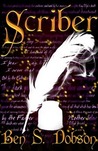
Fantasy Review: 'Scriber' by Ben S Dobson

Scriber
This is a book that surely strikes a chord with every avid reader: the society it describes is one recovering from the worst of all traumas, where all the books were burned. Not just a few heretical ones, but almost all of them. Just a few precious scraps of information remain from the collected history and scientific knowledge of the time before the burning. Dennon Lark, the scriber of the title, is an academic, dedicated to recovering as much of the lost knowledge of the pre-book-burning age as possible, wherever it may be found. But after an excavation of a possible book hoard site went horribly wrong, killing several people and destroying priceless religious artifacts, he ran away to a peaceful life in obscurity.

There wouldn’t be much of a story if he stayed there, though, would there? There are strange goings on in the land, Dennon hears voices in his head and a chance meeting with soldier Bryndine, the King’s niece, sees Dennon caught up in the defence of the kingdom. It’s the characters that shine here. Dennon himself is nothing at all like a typical hero – an almost pathologically reclusive academic, with no courage to speak of except in pursuit of his precious books. Bryndine fills the heroic role here, a woman of honour and unswerving devotion to her oaths and her people. She has gathered together a motley band of female warriors, of mixed backgrounds and personalities but all implausibly skilled at arms and of infinite courage and powers of endurance. And if that sounds eye-rollingly bad, they never came across as being the least bit cliched, so for me, at least, they worked.

The plot was a tad less successful. To say it was predictable doesn’t really do it justice. If our merry band rides into a rocky mountain pass on the cusp of winter, it doesn’t take a crystal ball to guess that there will be a) a snowstorm; b) an avalanche; or c) an attack of fearsome beasties. Or all three. Sigh. And I lost count of the times the search for some gizmo or other (in this book, it was a letter or journal or stash of books) ends in apparent failure, only for a chance remark to have Dennon suddenly say: ‘Oh, wait a minute, that gives me an idea...’.

The world-building, by contrast is rather good, even if everything interconnects rather too neatly. The writing is excellent (I didn’t notice a single typo, which must be some kind of record). However, I very much disliked the author’s habit of ending a chapter on a dramatic note, a fade-to-black or some other cliff-hanger, and opening the next chapter with: ‘I woke up to find...’. Bleh.

The ending is the expected grand battle which, to be honest, was so emotionally overwrought that I skipped most of it, as well as the endless pages of angsting that preceded it. Not my thing, I’m afraid. Nothing terribly unexpected happened, so for anyone looking for an original twist, this is not the book for you. Nor will you find any deep introspection or a profound philosophical treatise.

What you will find is a terrific adventure story with ever-escalating action, some unusual but convincing characters and a well thought out background. It’s dragged down a little by the slightly implausible ending, and the repeated attempts to evoke an emotional response and ramp up the stakes by killing and maiming characters (leave my favourite sidekicks alone, dammit!). On the whole, though, this is an excellent piece of fantasy. Four stars.

Saturday, 17 May 2014

Paranormal Urban Fantasy Review: 'Dark Visions' by Debbie Johnson

Dark Vision

I bought this for all the wrong reasons. It’s not my usual genre (paranormal urban fantasy) in any way, but... it’s set in Liverpool, and that was a huge attraction. There’s a special buzz in reading a book where the action takes place in Lime Street station, the Mersey ferry, Edge Hill, Sefton Park and even Bidston Hill, all places I know well. So I was prepared to take a punt on this, and step outside my comfort zone for a while. And it almost worked.

Lily McCain is a young woman with a secret: when she touches anyone, skin on skin, she gets a vision of their future. And however horrible it is, she can’t do anything to prevent it. No wonder she avoids contact with anyone, not easy given her chosen profession of music reporter for the local paper, which requires her to spend her time in packed clubs. But then one day a mysterious stranger turns up, tells her that she’s really, really special, so special she’s destined to save the world (or at least be his mate and have his babies), whereupon various other mysterious strangers start trying to kill her. And there’s a bunch about the Otherworld and the High King, and Ireland comes into it somewhere, and... OK, I got all fuzzy about the plot at this point. And really, it doesn’t much matter. There are good guys and bad guys, all right? And all Lily has to do is work out which is which.

There’s a lot to enjoy about this (besides Sefton Park having some kind of magic portal in it, which amused me no end). It’s an easy read, with some great humour, and Lily and her amusing sidekick Carmel are true feisty Scouse birds (when not curled up in wardrobes crying, that is). There are a few quibbles, though.

Quibble number one: vampires, because... no, actually, I don’t need a ‘because’. Just vampires. Ok, they’re background characters, and they have a goth band, naturally, which mitigates the effect, but really – vampires. It’s a testament to the strength of the writing that I didn’t toss the book (I’m SO allergic to the blood-sucking undead).

Quibble number two: scorching hot blokes (and some of the women too). Apart from Lily and Carmel, everyone seems to be impossibly hot and fit and awesomely honed. Which is kind of tedious. I like a bit more realism than that.

Quibble number three: logic failures. Now, I read a lot of fantasy, so I’m perfectly capable of believing six impossible things before breakfast, but the internal logic has to be consistent. And I just can’t accept that Gabriel (the aforementioned High King and Lily’s designated mate) would dump her at age six with one of the least sensible carers in the known universe. That makes no sense. And then only turn up again when there's a crisis looming only days away. She's in her twenties, for goodness sake, surely you could have dropped in a little sooner with the 'By the way, there's something you ought to know...' speech? And then there’s Lily herself. I lost count of the number of times someone said to her: whatever you do, don’t do X. And what’s the first thing she does? Of course it is. It’s a wonder she survived past chapter three.

Now, to be fair, these are all personal gripes of mine, and I’m sure the vast majority of the intended audience doesn’t care about a bit of wobbly logic. The writing is a little uneven – the scene where Lily returns to her nan’s house and emotes all over it goes on way too long, for instance. Plus there are numerous moments where the story felt contrived in order to squeeze in another famous Liverpool location (did we really need the entire history of the Cavern?). Those few quibbles aside, though, the story’s an entertaining read, with some great humour (only occasionally veering off into silliness), with an ending which avoided the easy options. An enjoyable three stars. Recommended for fans of vampires, hot blokes and Liverpool.

Paranormal Review: 'Life After Life' by Kate Atkinson

Life After Life

This is one of those books that I started with every expectation of hating it. It would be too pretentious, too clever for its own good, and too full of itself, I was sure of it. And the central conceit, of living the same life over and over, has been done a few times before. But then, quite unexpectedly, the quirky charm of the characters drew me in, and the excellent writing raised my hopes. I ended up enjoying it far more than anticipated, with a couple of reservations.

The story follows Ursula, the third child of Silvie and Hugh, who is born in the middle of a snowstorm in 1910. And promptly dies, the cord being tangled round her throat. And is born again. This time, she’s saved and lives a little longer. There are a great many deaths, in a great many different ways (and sometimes the same way, repeatedly), and some are pretty depressing, but knowing that Ursula will be reborn every time makes this less fraught than it might be.

As these various lives come and go and come again, Ursula starts to have some memory of her previous incarnations. These are not clear memories, but vague feelings of dread when in a place where something bad happened in a previous life, or a strong feeling that she should (or shouldn’t) do certain things. Her subconscious attempts to mitigate the effects or avoid a situation altogether are fascinating, and she gradually begins to adapt her life towards certain specific ends. It’s almost inevitable, given the timeframe here, that the whole killing-Hitler-to-prevent-the-war scenario should raise its head, but I won’t spoil the surprise by revealing what actually happens (well, it was a surprise to me, anyway).

The first reservation I had was that the heavy focus on the second world war, and the graphic descriptions of the lives that Ursula lived, made the mid-section of the book appallingly miserable. Nothing good seemed to happen to her at all. In all her many lives, there was no life where she simply met a nice man, married, settled down into baby-infested domesticity and had a pleasant, if dull, life. No, time after time, she lived miserably and died horribly, and I really resented that. Although possibly that was the entire point of her existence, I don’t know. Or some deep philosophical point: life’s a bitch and then you die and then (lucky you) you get to go through the whole awfulness of it all again.

But then the ending rolled around and this is where things went slightly off the rails, because (and I’m going to be honest here) I didn’t understand it at all. There were hints that some of the other characters also had some vague memories, but it wasn’t at all clear (to me). And the last chapter – what was that all about? It’s been driving me nuts. The blurb on the cover seems to suggest that, in true ‘Groundhog Day’ style, there will come a point when Ursula does everything right and the endless cycling will stop. Yet the book itself appears to contradict that. Or does it? Dunno. And what does it all mean? Dunno again. But the writing is very effective, the characters have a quirky, and very English, charm, and on balance I found it an enjoyable read. The deeply depressing wartime scenes and cryptic ending keep it to three stars.

Wednesday, 14 May 2014

Romance Review: 'Scandal's Heiress' by Amelia Smith

Scandal's Heiress

I don’t read much Regency romance these days, although at one point in my life I worked my way through the entire Georgette Heyer catalogue, multiple times. And Jane Austin remains a favourite. I still have a soft spot for the genre, but recent forays have been less than satisfactory – either too silly for words, or too cavalier with historical accuracy. I see no reason why a romance set in historical times shouldn’t provide something more substantial than meringue to chew on, and also be true to the nature of those times, without being too pedantic about it.

This book manages to please in both areas. The plot is the usual romance formula: boy meets girl, there’s an instant attraction but insuperable problems, they gradually work their way towards a happy ending. However, the author sidesteps the now customary pitfalls: there’s no insta-lurve to stretch credibility, just the attraction between the only two people of a certain age on board ship for a long journey, kept in check by common sense. I liked the way this was handled very much. And the problems are real ones, arising from family history, social status and the personalities of the couple themselves.

The main characters, Hyacinth, raised in Gibraltar, and Thomas, who’s spent most of his adult life in India, are both outsiders, which gives them a natural affinity. Hyacinth has inherited a small estate from a disreputable relative, and Thomas is now the heir to both wealth and a title, but neither want to conform to society’s expectations of them. They’re both smart, too, making sensible decisions. I liked both of them.

The historical setting is sketched in quite lightly (although everyone’s seen Pride and Prejudice and knows what this era looked like), but there’s enough detail to bring the period to life. The descriptions of life aboard ship were particularly effective, London a little less so (Thomas’s family’s house seemed vastly too big even for a family of such high social standing). However, the author has a very fluid way of handling titles and forms of address. For example, the hero, Thomas Smithson Pently, is routinely addressed as ‘Sir Pently’, which had my inner pedant screaming ‘What kind of title is that when it’s at home?’ I’ve given up reading some books for oddities like this, but here the charm of the main characters kept me going.

The plot burbles along very nicely, although I rolled my eyes a little when the heroine’s inherited estate turned out to be right next door to the hero’s family acres. Hmm... But it all wraps up beautifully, the obligatory sex scene is nicely judged and the ending is neither too glib nor too sickly-sweet sentimental. I enjoyed it very much. Well-drawn characters, elegantly written and with more to chew on than usual in a romance – highly recommended. Four stars.

Tuesday, 6 May 2014

Fantasy Review: 'The Lascar's Dagger' by Glenda Larke

The Lascar's Dagger (The Forsaken Lands, #1)

Glenda Larke is one of a very small number of authors whose works are on my must-buy list, and a new book, and the first of a series to boot, is always cause for celebration. Larke writes a traditional kind of fantasy, not the elves and dwarves sort, but the type that relies on a refreshingly original created world, engaging characters and a story that compels right from the first line. And it doesn't hurt that she has a wonderfully vivid writing style.

So why does this one not quite set me on fire? I think it’s because there are so many elements that feel very unoriginal, not to say tired. Parts of the world feel like just another pseudo-medieval setting, the parts that involve the patrilineal kingdom with the cold-hearted king, the playboy prince and the resentful but plucky princess, doomed to marry some hideous older man for political reasons. Yawn. And I’m always deeply suspicious of kings who have precisely two children, one of each gender. In a hereditary monarchy, there should be hordes of hopeful heirs, legitimate and otherwise, in every generation, or else an extremely good reason why not.

Other parts of the story are well up to Larke’s creative standards. The unusual physical world, with the continents clustering inconveniently around the polar ice-cap. The importance of the spice trade. The uneasily united branches of the prevailing religion. And the dagger of the title, a creepily semi-alive weapon. I’m a sucker for sentient ironmongery.

The main character of the story is Saker, low-born but now a pretend priest and spy, working undercover for his religious mentor while supposedly tutoring the royal children. And here’s another problem. Saker is a likeable enough character, but he’s made out to be some ultra-smart, ultra-devious guy, when the entire book is no more than a catalogue of his mistakes, where he’s taken in by one smarter, more devious character after another. Gullible is his middle name, and while I excuse his entrapment by the lady (he’d have to be super-human to resist, frankly), the rest of it just makes him look stupid. And I have to wonder why his mentor sends him off to tutor the prince and princess in the first place, a position he seems spectacularly unsuited for.

Of the other characters, Ryke the prince is the standard template for princes in fantasy, only interested in hunting, whoring and himself. Mathilda the princess has an even more limited range of interests – herself and... erm, that’s it. And yes, of course, it’s a horrible situation, young woman forced to marry evil older man for the good of the kingdom (and a lucrative trade agreement), but we have heard it once or twice before. Sorrel, the widow coerced into virtual slavery by Mathilda, would be more interesting if she stopped whining for five minutes. Yes, life’s really tough living in the royal palace with all your comforts provided, isn’t it?

Ardhi, on the other hand, the original owner of the eponymous dagger, is a truly fascinating character. More of him, please. Saker’s religious mentor, the Pontifect, is also interesting, and I also enjoyed the few moments onscreen of light-hearted nobleman Juster (although he reminded me somewhat of Maldynado from the Emperor’s Edge series; actually quite a few of these characters reminded me of some other book).

The plot is a little slow to get going, although that’s typical of most fantasy and isn’t a problem. It takes time to paint in the backdrop before the action starts. Once it does, though, things take off spectacularly, and the second half of the book is a fast-paced romp as Saker and pals stagger from one disaster to the next. Beneath the veneer of entertainment, though, there are some thought-provoking themes – of slavery, for one thing. Several of the characters are, in various ways, compelled to do things they desperately don’t want to do. This ought to make me more sympathetic towards them, but somehow it feels more like a plot device and therefore loses its emotional impact.

This fell a little short of my expectations. It felt uneven, the characters failed to engage me, the plot, while executed with all the author’s flair, seemed a little contrived. Political machinations are less interesting to me than well-rounded characters. However, the writing is, as always, excellent, and the foundations are laid for the next two books in the series to venture out of the familiar world of kingdoms and organised religions into more exotic settings. I’ll certainly be reading on. Three stars.

Sunday, 27 April 2014

Fantasy Review (DNF): 'Oblivion's Forge' by Simon Williams

Oblivion's Forge


The word that springs to mind while reading this is portentous. The opening chapters are stuffed with mysterious happenings, deeply meaningful but unexplained dreams and visions, characters who are compelled to do certain things and who are assisted at life-threatening moments by shadowy mystics. Something Very Bad is about to happen, and it’s so bad that it can only be spoken of in cryptic utterances that the reader will come to understand by the end of the book (or possibly the end of the trilogy, who knows). And all this in a deeply hostile wintry landscape.

So clearly this is dark fantasy, which means the characters will suffer many unpleasant experiences on their journey through the plot. And I’ll be honest, I just wasn’t in the mood for it. Sometimes I just want entertainment rather than gruesomeness. Sometimes I just want to know what the hell’s going on. Sometimes I get tired of these fantasy worlds where everything is gloom and misery, and there isn’t even a decent tavern brawl. So mea culpa, this is just a mismatch between the book and me.

And I’m a bit cross, because beneath the mysticism, this is a wonderfully literate and thoughtful piece of work, which normally I would be lapping up. The author has an almost lyrical style which is a pleasure to read, although he’s a bit inclined to toss in a lot of backstory (all of it portentous, naturally, and not at all explanatory). The world itself is very well thought out and there’s plenty of magic of various sorts going on.

For anyone who likes their fantasy dark, cryptic and thoroughly mystical, this is an excellent, well-written example. Sadly, it wasn’t for me. I got 15% of the way in before giving up. One star for a DNF.

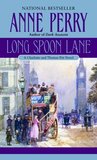
Mystery Review (DNF): 'Long Spoon Lane' by Anne Perry

Long Spoon Lane

If I’d known going in that this was the twenty-fourth book in this particular series, perhaps I might have expected some problems. But it was a book group read, recommended by one of the members, and it seemed to be right up my alley – a murder mystery set in Victorian times. Well, that sounds like fun, doesn’t it? Something light and entertaining, but with a more interesting background than the usual inner-city fare or the Marple-esque twee rural village beloved of the writers of cosy mysteries.

But all that backstory inevitably cast a pall over proceedings. This is not the sort of series where everything resets at the end of each book. It’s clear that there have been years (perhaps decades) of interaction between most of the principle characters. To say they have history doesn’t begin to cover it. To be fair, the author fills in the details pretty well, and it wasn’t too confusing. The problem was that the earlier events sounded so much more interesting than this book. The lead character’s wife, Charlotte, for instance, and her sister Emily, who are nothing more than domestic goddesses in this book, appear in some earlier existence to have done a great deal of sleuthing on their own account. Now that’s a book I would willingly read.

Then there was the subject matter of this particular story, which revolves around anarchists, corruption in the police force and a plan to introduce laws to allow the police to be armed and to have greater powers in their investigations. Since it’s well known that the British police are not routinely armed to this day, there’s no dramatic tension in that particular plot line. It seems to be merely a platform for the author to express her own views through the characters, who hold endless worried conversations about how dreadful such a step would be, and blah blah blah. Yes, yes, but it gets old very quickly.

None of this would have mattered if the plot had ripped along or the dialogue sparkled or the characters were lively, but sadly, it was not so. After the initial excitement of bombings and shootings (where our hero Pitt repeatedly displays his over-sensitive horror at such dreadful goings on in England), the plot settles into a rather dull political affair. The writing style is loosely in the manner of Victorian novelists, although with intrusive diversions to explain subtleties of social propriety which the reader is (presumably) too stupid to understand otherwise. None of the characters really came alive for me, but perhaps they were constrained by the formality of the era. There were moments where the author captured the atmosphere of London in a truly evocative way – the scenes beside the river, for instance – but mostly the writing was workmanlike rather than compelling.

I suspect that the earlier books in the series were much more readable. This felt like a tired effort, where the author had run out of ideas and possibly even interest in the series, but was soldiering on in the interests of fan satisfaction. No doubt those who’ve read the preceding 23 books will love this one, but it wasn’t for me. I got to 30% before I gave up on it. One star for a DNF.

Sunday, 20 April 2014

Fantasy Romance Review: 'Sarya's Song' by Kyra Halland

Sarya's Song

Wouldn’t it be lovely if you could compose a song which would guarantee good weather or bountiful harvests or a cure for illness? That’s the premise here, and what an enchanting one it is. The creator god made the world and left a series of specific tunes (‘tropes’) which allow the humans to control their environment and live in peace and plenty. The god has moved on to other worlds but the tropes should carry on working indefinitely – except that something is going wrong. Harvests fail, epidemics break out, the weather has turned nasty and no one knows why.

Sarya is a part of this magical-music world, having both a True Voice (one which can affect things by singing) and being also a trained Arranger, someone who takes the required tropes and combines them into an effective choral arrangement. Inevitably (this is fantasy, after all), she’s an orphan with a rough past, whereas most of the people at the Skola (musical academy) are upper class and wealthy, so she has had trouble being accepted into the community. But when one of her arrangements goes disastrously wrong, Sarya is determined to find out why and begins researching the strange tropes which accompany the disasters.

From here on, the plot accelerates at a dizzying speed, and this part of the book is perfectly judged, with each success followed by a greater failure, and Sarya forced into more and more difficult decisions. There are some darker passages towards the end, but I didn’t find them too unsettling, and I liked the mature way the author handled the consequences of traumatic experiences. There were a few credibility issues, where I expected greater opposition to Sarya’s proposals, but in the end people just said, ‘Oh, all right then.’ And Sarya’s conviction that love interest Adan couldn’t possibly love her despite all the evidence to the contrary was not terribly believable. I mean, that passionate kiss should have been a bit of a clue, right? But the action rolled on unstoppably, and every crisis was page-turningly dramatic. This was a book that was hard to put down, and although there was nothing wildly original in the way events played out, it was still an exciting read.

Fantasy romance (or romance in a fantasy setting) is a difficult genre to pull off. It’s hard to get the perfect balance without one aspect swamping the other, but the author has done a terrific job here. The world-building is not extensive, since almost all the action takes place within the city of Sucevita, indeed within the Skola, but other areas are mentioned sufficiently to give the setting a feeling of real depth, both of geography and history. The religion, based around the magical tropes, is also well-conceived. The romance happily avoids the insta-lust and triangle clichés, and is enjoyably satisfying without ever overwhelming the action.

If there is a weakness to the book, it lies with the characters. Sarya is too impossibly altruistic and self-effacing and robustly determined to do the right thing no matter the personal cost, and the angst factor is quite high in consequence. Adan is too impossibly noble and generous and self-sacrificing and understanding. He’s also impossibly handsome and well-honed and a perfect specimen of manhood, but that’s par for the course for this kind of story, and I’m certainly not going to complain about it. Both main characters have their frailties, of course, but these pale beside their vast array of virtues. The other characters fall neatly into the good guys/bad guys duality, without too many distinguishing characteristics.

These are very minor quibbles however. On the plus side, the villain was chillingly evil, and one of the highlights of the book for me. His meetings with Sarya were wonderfully mysterious, and I enjoyed the way his true intentions were concealed until the last possible moment. Sarya’s past also gives her some depth, and the moment when she overcomes her history and gives herself unreservedly to Adan is a lovely piece of writing.

This was a very enjoyable read, a perfect blend of well-thought-out fantasy with a satisfying romance. I loved the ingenious and cleverly implemented concept of music as a form of magic. Highly recommended. A good four stars.

View all my reviews

Saturday, 19 April 2014

Mystery Review: 'Charity Begins With Murder' by Annie McDowall

Charity Begins with Murder

This is a quirky little book, filled with eccentric characters who are nevertheless completely believable, reacting to an increasingly dramatic sequence of events exactly as you would expect normal people to react. The first response to new information or a threat is always ‘let’s tell the police’ instead of the all-too-common policy in amateur sleuth stories of attempting to deal with everything single-handedly.

The plot: Nikki is out of work and depressed after a traumatic event at a previous job, forced back into work by the government’s ruthless program to reduce the unemployment numbers. She reluctantly takes a job as receptionist for a charity in a seedy part of London, where her boss dies in the middle of a meeting on Nikki’s first day at work. And from there onwards, things get steadily worse.

Nikki is a fairly likeable character, and her friends are an entertaining bunch. I don’t know London very well (I live at the other end of the country) but I did wonder how realistic it was to find quite so many gay, black/coloured, disabled and otherwise minority groups in an area who were all such cheerfully nice people, while the middle-class white folks were – well, less nice, in many cases, and downright creepy and villainous in some. It seemed a little like inverse type-casting. In my experience you find good, bad and downright weird in all ethnicities, and always more good than bad. I was half hoping that one of the minority characters would turn out to be a villain or at least pilfering the coffee money, just to redress the balance a bit, but no.

The early chapters were a little slow, and it took forever to determine that the initial death was indeed murder and not merely a tragic accident, which was frustrating given the book’s title. After that, the story unfolds very nicely, and winds up to fever pitch at just the right moment, although the reveals weren’t terribly surprising. The book is easy to read, although the author likes to detail every little part of each conversation, however banal. I’d have preferred a little more snappiness, but that’s just me.

I found the romance element a little too dominant for this kind of plot where the murder should be the main feature – and no, that’s not just because it involved a lesbian love triangle. I thought the new romance was rather sweet and beautifully judged, but the old flame angle got a bit tedious after a while. Too much angsting for my taste. However, for anyone who dislikes gay characters, be warned: the main character and most of her friends are gay, the gay lifestyle dominates and there is some (tastefully done) sex.

An entertaining, if light-hearted, read, with some well-drawn characters and a good sprinkling of British humour. I would have liked a little more unpredictability and perhaps a tad less political soap-boxing. Three stars.

Thursday, 3 April 2014

Steampunk Review: 'Emperor's Edge' Short Stories by Lindsay Buroker


Ive been catching up with a few short reads these past few days, which does wonders for the tbr list. Theres not enough to say about these to justify a review each, so Ive gathered them into a compilation.

Shadows Over Innocence (Emperors Edge 0.5)

A nice little short story giving a glimpse into the background of Sicarius the emotionless assassin and Sespian the future Emperor as a child. One for the fans, and best read after some of the Emperor's Edge series to fully appreciate the nuances. Two stars.

Ice Cracker II and other stories (Emperors Edge 1.5)

The Frozen Water Trade, Through Fire Distilled, Ice Cracker II

These are fun, light-hearted reads which follow a similar formula: Amaranthe is going about her business when she stumbles across a dead body or an exploded machine, leading her to investigate, whereupon things get much, much worse. Two stories feature Sicarius, and one has Books in it (but sadly theres no sign of Maldynado). Three stars.

The Assassins Curse (Emperors Edge 2.5)

A nice spooky haunted island is the star attraction here. Amaranthe and Sicarius are training in the lake when they spot something odd going on. Can Amaranthe resist investigating? Of course not. This leads to an encounter with another of the authors ingenious steam-powered machines, and the usual implausible but entertaining fight scene. Three stars.

All of these are recommended for fans of the Emperors Edge series, although there isnt a whole lot of backstory revealed. Theyre also a pretty good introduction to the authors steampunk world and mayhem-and-explosion-rich style of adventure.