Pages

Showing posts with label larke. Show all posts

Tuesday, 12 August 2014

Fantasy Review: 'The Heart of the Mirage' by Glenda Larke

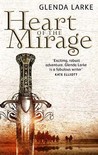
Heart of the Mirage (Mirage Makers, #1)

So here we are in the Roman Empire - sorry, no, not the Roman Empire, definitely not, this is fantasy after all. This is Tyrans, nothing to do with Rome. But - centurians and latin-esque names and so forth. Well. For some people, it doesn’t much matter, but for me I prefer the ‘vaguely inspired by’ type of world-building, rather than ‘pretty damn close’, with a few novelties thrown in. So that’s the first hurdle, a not terribly imaginative backdrop to the action.

The second problem is the main character, Ligea, a woman from recently subdued Kardiastan, taken as a child and brought up as the adopted daughter of a famous general. When you realise how much her compatriots are despised, the arrogance of the Tyranians and also that slavery is legal, this strikes me as an extraordinary thing to do, to take a foreign child into your house and raise her as your own. Even when the reasons for it become clear, it's pretty silly. It makes her a peculiar mixture: she has the arrogance of her adoptive land, as well as education, and an unquestioning acceptance of the ways of the victors, believing that slavery, for instance, is perfectly sensible and proper, yet she’s still seen as a foreigner.

Now there’s nothing wrong with the setup, it’s an interesting scenario, but it makes Ligea a horribly unlikeable character. It also makes it blindingly obvious when, in chapter 1, she is told she is to go to Kardiastan, that she’s going to have a revelation and realise the error of her ways, rediscover her roots and all that. That’s fine, so long as the way she gets there is convoluted and filled with unexpected twists. And there are some twists, it has to be said, but all the interest (for me) lies in the relationships between Ligea and her slaves and the people she meets in Kardiastan. The plot, such as it is, never really rises above the ho-hum, although there are one or two nice reveals along the way.

The other characters are quite interesting, more interesting than Ligea herself, in fact, and at least some of them behave logically and sensibly, unlike her. She seems to follow her emotions when it suits the plot and logic at other times. I liked her best when she was reading the books helpfully provided by the Mirage and working things out for herself, using the incisive brain we were told about many times, but rarely saw.

The magic - sigh. Yes, let's talk about the magic. This is one of those worlds where those select few who have magical capability can do pretty much anything they want with it, except things that would make the plot too simple. They have to learn how to use it, and there is a price to be paid for it, but sometimes it seemed as if, whenever there was a crisis, someone would say - but didn't you know, you can just do X? And Ligea does X, and lo, she is saved. Well, that's not really very interesting.

Once we get away from Rome - sorry, Tyrans, and into Kardiastan, the world-building perks up a bit. The Shiver Sands and the Mirage are fantastic creations, and the author is always wonderfully inventive with animal life. I loved the gorclaks and shleths, and the descriptions brought everything - the buildings, the people, their clothes, even the earth - to glorious life. And if the plot went on pretty much as predicted, still it was fun and a dramatic ride.

But the ending - that was a real bummer. I expected, or at least hoped, that there would be some *emotional* resolution, some conclusion at least to the relationships tangle even if the plot rumbles on into book 2. But no, Ligea reverts to her illogical, and (frankly) downright stupid self, and there's an all-too-convenient bit of arm-waving regarding one of her slaves, presumably for plot-related reasons. Sorry, but you can’t just say ‘X had changed’ so everything’s suddenly all right. It was very disappointing. I've already bought the rest of the series, so I'll undoubtedly read it at some time, but I'm not in a rush. Three stars.

Tuesday, 6 May 2014

Fantasy Review: 'The Lascar's Dagger' by Glenda Larke

The Lascar's Dagger (The Forsaken Lands, #1)

Glenda Larke is one of a very small number of authors whose works are on my must-buy list, and a new book, and the first of a series to boot, is always cause for celebration. Larke writes a traditional kind of fantasy, not the elves and dwarves sort, but the type that relies on a refreshingly original created world, engaging characters and a story that compels right from the first line. And it doesn't hurt that she has a wonderfully vivid writing style.

So why does this one not quite set me on fire? I think it’s because there are so many elements that feel very unoriginal, not to say tired. Parts of the world feel like just another pseudo-medieval setting, the parts that involve the patrilineal kingdom with the cold-hearted king, the playboy prince and the resentful but plucky princess, doomed to marry some hideous older man for political reasons. Yawn. And I’m always deeply suspicious of kings who have precisely two children, one of each gender. In a hereditary monarchy, there should be hordes of hopeful heirs, legitimate and otherwise, in every generation, or else an extremely good reason why not.

Other parts of the story are well up to Larke’s creative standards. The unusual physical world, with the continents clustering inconveniently around the polar ice-cap. The importance of the spice trade. The uneasily united branches of the prevailing religion. And the dagger of the title, a creepily semi-alive weapon. I’m a sucker for sentient ironmongery.

The main character of the story is Saker, low-born but now a pretend priest and spy, working undercover for his religious mentor while supposedly tutoring the royal children. And here’s another problem. Saker is a likeable enough character, but he’s made out to be some ultra-smart, ultra-devious guy, when the entire book is no more than a catalogue of his mistakes, where he’s taken in by one smarter, more devious character after another. Gullible is his middle name, and while I excuse his entrapment by the lady (he’d have to be super-human to resist, frankly), the rest of it just makes him look stupid. And I have to wonder why his mentor sends him off to tutor the prince and princess in the first place, a position he seems spectacularly unsuited for.

Of the other characters, Ryke the prince is the standard template for princes in fantasy, only interested in hunting, whoring and himself. Mathilda the princess has an even more limited range of interests – herself and... erm, that’s it. And yes, of course, it’s a horrible situation, young woman forced to marry evil older man for the good of the kingdom (and a lucrative trade agreement), but we have heard it once or twice before. Sorrel, the widow coerced into virtual slavery by Mathilda, would be more interesting if she stopped whining for five minutes. Yes, life’s really tough living in the royal palace with all your comforts provided, isn’t it?

Ardhi, on the other hand, the original owner of the eponymous dagger, is a truly fascinating character. More of him, please. Saker’s religious mentor, the Pontifect, is also interesting, and I also enjoyed the few moments onscreen of light-hearted nobleman Juster (although he reminded me somewhat of Maldynado from the Emperor’s Edge series; actually quite a few of these characters reminded me of some other book).

The plot is a little slow to get going, although that’s typical of most fantasy and isn’t a problem. It takes time to paint in the backdrop before the action starts. Once it does, though, things take off spectacularly, and the second half of the book is a fast-paced romp as Saker and pals stagger from one disaster to the next. Beneath the veneer of entertainment, though, there are some thought-provoking themes – of slavery, for one thing. Several of the characters are, in various ways, compelled to do things they desperately don’t want to do. This ought to make me more sympathetic towards them, but somehow it feels more like a plot device and therefore loses its emotional impact.

This fell a little short of my expectations. It felt uneven, the characters failed to engage me, the plot, while executed with all the author’s flair, seemed a little contrived. Political machinations are less interesting to me than well-rounded characters. However, the writing is, as always, excellent, and the foundations are laid for the next two books in the series to venture out of the familiar world of kingdoms and organised religions into more exotic settings. I’ll certainly be reading on. Three stars.

Monday, 11 March 2013

Fantasy Review: 'Havenstar' by Glenda Larke

This was the author’s first published work, but shortly after its appearance in 1999 the publisher sank, and the book with it. Now the author has self-published it (hurray for the digital age). Not only is it available once more, it has been picked up by a traditional publisher too. A result whichever way you look at it.

The story has one of the most original settings I’ve encountered. A cataclysmic event tore the world apart, spreading chaos everywhere apart from a few islands of stability which are kept that way by rigorous adherence to a religion-based system of rules. Travel between these islands is made possible by accurate mapping of the chaotic patches between them. Main character Keris is the daughter of a mapmaker who dies under mysterious circumstances in the unstable lands between islands, and she is forced away from her home as a result. And that doesn’t begin to describe the complexities of this world.

There’s no easy entry here. The reader is dropped into this complicated background without a parachute, so the early chapters are riddled with jargon and references to unexplained events, places, people. It isn’t long, however, before explanations begin to appear, and although it took me a long time to work out the differences between tainted, unbound, excluded, unstablers, ley-lit and the like, things do become clearer. The ley lines are the most significant element; these are the ever shifting rivers of chaotic energy which criss-cross the landscape, the source of power for Carasma, the lord of chaos and his minions.

Keris is accompanied on her journey into the unstable world between the eight stabilities by a motley collection of people - a priest following orders, a high-ranking man making a pilgrimage alone, a brothel-keeper repenting of her sins, a timid man trying to impress his father and so on. The guide, Davron, and his tainted assistant, Scow, seem almost normal by comparison. And then there's the mysterious Meldor, who is blind but surprisingly adept for all that. All of them feel like real, fully rounded people, and if they aren’t exactly people you would meet down the pub (Scow is described thus: ‘His head was built on a grand scale, perhaps twice normal size, and his outsized face was circled by an animal’s mane. The hair—fur?—of it cascaded down on to his shoulders, hiding his neck.’), they all have their own secrets and tragedies. The tainted, in particular (those caught out while crossing a ley-line and transformed in some way) are very tragic figures, unable to return to the stabilities, unable even to touch other people. Davron is particularly tragic, and the way he and Keris gradually come to understand one another, and the development of their slowly unfurling love story, undeniable and yet impossible, is masterfully done.

The story is intriguing right from the first page, and quickly builds to a fast paced and dramatic adventure. The consequence of a world infused with chaos is that anything can happen at any moment, creating a tale which crackles with tension and (I’ll be honest) fear; some of those tainted and wild creatures were pretty horrifying. And yet there was always humour, too, especially from Corrian, the pipe-smoking former brothel-keeper with her down-to-earth attitude and appetite for life, and the timid Quirk, who takes to life in the unstable world with surprising nonchalance.

The religion of this world is not, at first sight, much different from any other hierarchical, rigid, dogmatic religion, but beneath the surface it’s unusual. For one thing, it’s an integral part of the division between stable and unstable areas. The stable zones are maintained by the continuous application of kinesis (a kind of gesture) around the borders and rigorous adherence to exhaustively detailed rules within the boundaries, which prescribe what may be grown where, what colours and styles of clothing may be worn, how many children may be born and what jobs they can do. All of this is intended to minimise the number of changes occurring and thus maintain order, a kind of stultifying stasis. Inevitably, this leads to some painfully inhumane results. Babies surplus to the permitted two are removed at birth and brought up in the religious order. Those who are deformed or who defy authority are thrown out of the stabilities altogether, left to survive as best they can. Inevitably, such a system has its share of the secretly defiant, the petty tale-tellers and the corrupt, who will bend the rules or turn a blind eye for a consideration. I wasn’t sure whether the author was making a general point about organised religion, but I found it very thought-provoking.

This book is awesome. It has all the characteristics I look for in fantasy: an original, well thought out world, a simple but powerful magic system, compelling characters who behave realistically, and a plot which never lets up for a moment. It’s emotionally engaging, too; I always cared about the characters and there were moments that reduced me to tears. Keris the map-maker’s daughter is a fantastic heroine, and the ending - well, the ending was perfect, I can’t describe it any other way. A truly wonderful story. Five stars.

Wednesday, 7 September 2011

Review: 'Stormlord's Exile' by Glenda Larke

And so on to the final part of the 'Watergivers/Stormlords' trilogy. At this point, I'm sufficiently invested in the characters and their world to care deeply about what happens to them. I have no expectations, going in, as to where the story will end up. The obvious possibility is a simple return to the status quo - Shale and Terelle will succeed in finding a new source of water-power (whether from the mysterious Khromatis or elsewhere) and everyone will settle down to rebuild the Scarpen cities with water supply assured.

But there are other potential outcomes too. It may be that the stormlord approach will fail utterly, and there will be a return to the time of random rain and everyone will have to adjust to a new, more flexible, way of life. But there is also the question of why there is a problem with rain in the Quartern at all, given that elsewhere water is plentiful. So it may be that some way will be found to change the climate entirely. This will still require a lot of adjustment, but it might be a better long-term solution. So the author could go in any one of a number of different directions, all with satisfying and emotionally resonant endings.

There are some implausibilities creeping into the plot, the convenient secrecy of the Alabasters, for instance. And Shale's propensity for rushing off to deal personally with whatever crisis is going on makes for an exciting ride, and is consistent with his personality and age (he's still a teenager, after all), but it isn't very sensible, given that he's the only stormlord left in existence. And I have to agree with the (several) characters who pointed out to him that going off to talk to his hostile brother in his own camp, and almost unaccompanied, is a seriously stupid thing to do.

And then there's Bice and his motley collection of sons. The bad guys have been a little too openly evil right from the start, but at least the likes of Taquar and Laisa have a certain charm. Bice, however, has none, and I find it difficult to accept a character who is so instantly aggressive and murderous. I like my villains to have at least a little personality. Besides, the obvious response to Terelle turning up out of the blue in Khromatis is to disbelieve her story entirely. She can't become Pinnacle unless she is accepted as the rightful heir, yet Bice never questions her ancestry.

Somehow this book seems a little more uneven than the previous two. Minor skirmishes early on become unexpectedly fraught, while other situations which should have been hazardous or difficult pass off unexpectedly easily, almost frivolously. The acquisition of new stormlords passes almost without comment, even though all indications are that the Khromatis will be highly unwilling to help out, and one of them, at least, is taken forcibly. Virtually nothing is said about whether their powers are even suitable (I recall just one casual comment), even though this is a crucial factor in the entire trilogy. Some aspects of the plot, and some minor characters, are dealt with in an almost perfunctory way. There were a number of places, too, where I lost track of who was speaking and had to reread carefully to work it out. This happens occasionally in every book, but it seemed a lot more frequent here than in the previous two. And there were quite a few small typos towards the end, as if the author was rushed.

I also felt there were some loose ends left dangling. I half expected Bice to make a reappearance, for instance, and I was surprised we never heard how Jade learned of what happened to her two sons. Much was made of keeping this from her, so I would have expected the point to be resolved. Nor did we ever find out how Khromatis coped with the loss of the rightful heir. Again, much was made earlier of the point that the position of Pinnacle was inherited and there could be no other option. And we never did find out exactly why the Quartern had so little rain when seemingly other parts of the world were generously supplied. I suppose it was just a climatic shift, but it would have been nice to know if this was natural or man-induced or magical, at the least.

But, niggles aside, the major plot points were resolved in suitably dramatic and satisfying ways (some twists I saw coming, but others were a complete surprise). The final confrontation with Ravard was particularly poignant, encompassing both tragedy and humanity. I didn't foresee Shale's final decision, but it made sense. The last chapter felt slightly rushed, though - not much more than a quick summary of where everyone ended up, almost as an afterthought.

Overall, this is a nice example of what fantasy should be. Larke's world-building is excellent, and while the level of detail is no more than in many other books, she is quite brilliant at keeping the reader fully immersed. She is a painter with words, using just a few brushstrokes here and there to sketch in the background in the most economical way. She uses a few simple tricks ('ye be going...' or 't'see...') to suggest the dialects of the White Quarter and the Gibber Quarter, and even the multitude of swearwords (sunfried, sandbrain, pedeshit...) constantly reinforce the hot, arid nature of the Quartern and its sheer differentness. It's great fun to visit Khromatis in this book, and encounter natural rain (and even snow!) from the perspective of the water-starved Quartern folk. The plot rattles along nicely, building slowly but inexorably to the major confrontations, which are not always resolved by brute force. In addition, the main characters are likeable, but with enough quirks to make them interesting, the magic system is both simple and powerful (and creates numerous entertaining and original ways of fighting and overcoming obstacles), and the plot derives almost entirely from the situation. Only the slightly over-the-top evilness of the bad guys detracts, and mostly there is enough depth to make them believable.

I always like a book that makes me think, and there's plenty here to ponder - the origins of religion, for instance, or the nature of prejudice (each of the regions has its own set  - Scarpen folk are scathing about dark-skinned 'Gibber grubbers', but perfectly accepting of sexual preferences), or the necessity for killing, even in time of war, and whether you would ever sacrifice the life of your own child for the greater good. Then there is the matter of family loyalty and how far it should stretch. And perhaps the largest question of this book, set in a land of severe water shortages - how to distribute what resources you have, and whether it's better to build vulnerable cities or try to live more simply in harmony with the landscape. Cleverly, Larke never beats the reader over the head with her own views. Rather she allows her characters to put forward the alternate positions, so that, for example, when two infants are (separately) held as hostages, their fathers take different stands on whether to try to preserve the child's life, whatever the cost. All in all, this is very elegantly done.

I have to say that it's a long time since I've enjoyed a fantasy trilogy this much. Often they start well, but bog down in overly complicated plot developments, or the characters fail to develop believably, and more often than not they concentrate on the action scenes or the grand confrontation in book 3 to the detriment of everything else. Larke avoids these pitfalls, and adds a layer of subtlety, and a spare, clean writing style, which make every chapter a joy to read. I don't often give 5 star reviews, and by itself this book would perhaps just fall short, but the overall quality of the series deserves it.

Thursday, 1 September 2011

Review: 'Stormlord Rising' by Glenda Larke


This, the second in the 'Watergivers' trilogy, picks up exactly where the previous one left off, in the immediate aftermath of battle, and the surviving characters are all plunged into crisis without preamble. Having grumbled in my review of book 1 that so many major characters died, my complaint this time is over the number who miraculously survived, despite being believed dead. I suppose there's just no pleasing some people. Given all these unlikely reincarnations, maybe we will yet see Lyneth and Moiqa? Well, maybe not.

The events of the previous book and the background of the Scarpen cities and their rainlords and stormlords are sketched in rather briefly here and there, but it might not be enough for anyone coming back to the story after a long gap. The pace is rapid from the start and never lets up, so anyone who's not up to speed on the story so far is liable to get left behind.

All our main characters are trapped in situations not of their making. Terelle is a prisoner of Russet's water-painting magic, Shale is forced to work alongside the devious Taquar, while Ryka and Kaneth are slaves of the Reduners, the dune nomads. This creates real tension, and the plot races along as they all work to set themselves free (with varying degrees of success), although not without useful dialogues which serve to keep the reader well informed about all the various options. It is a little surprising, actually, how often these people sit down in the midst of dire circumstances to talk at great length, and this reaches ridiculous levels near the end when Shale and Ravard hold a full conversation in the middle of a massive battle.

The world-building is necessarily less detailed in this book, but we do move out of the Scarpen cities and into some of the other regions. We saw a little of the Gibber plains last time out, but this time we also see the Red Quarter (home of the dune tribes) and the White Quarter (the salt plains of the Alabaster folk), and both of these are interesting scenically and in their societal structures, as well as giving us some insight into the economics of Quartern life. We haven't yet seen the coast or the mysterious Khromatis region, but perhaps that will come in book 3.

It is nice to learn more about the indigenous lifeforms, notably the seriously scary ziggers, truly the stuff of nightmares, and the ubiquitous pedes, used for both riding and carrying. Rather delightfully, the pedes turn out to have personalities and memory, and even affection for humans who treated them kindly in the past, which is unexpectedly charming. I never would have thought I'd consider giant creepy-crawlies in terms of 'Ah, how sweet!' but that's fantasy for you.

We also learn something of the various religions - the dune gods of the Reduners, the One True God of the Alabasters, and the delightfully earthly origin of the Sungod worshipped in the Scarpen cities, the giver of water-powers. This is hugely entertaining stuff. I particularly liked the thought tossed out, almost as an aside, that the innate water-sensing ability is god-given and not magical at all, while the power of water painting is sorcery and therefore totally evil. This is, of course, a question which should be considered by all fantasy writers (and readers, for that matter) - what exactly is magic anyway?

The characters continue to be interesting and (sometimes) to behave in unexpected ways. The changes to Kaneth as a result of his injuries are particularly intriguing, although his rapid recovery is slightly implausible. Most of the main characters are likeable and believable. The bad guys are still a little too bad to be truly credible, but on the whole (Taquar and Ravard in particular) they have enough depth to be more than just cartoons. I particularly like Kaneth and Ryka (and Kaneth's friend), and all the squabbling rainlords (even Laisa and Senya). And I love the slightly bonkers Iani. And Shale and Terelle are OK too. Shale has grown up big time in this book, although still with an adolescent's peculiar combination of angst and over-confidence, and Terelle is getting there too.

Ravard is especially interesting. I don't suppose the revelation of his identity surprises anyone, but it's still fascinating to see the man he's become. I do have an issue with his behaviour, however. I'm not a psychologist, but I would have expected a boy who was abducted and enslaved, and who then worked his way up to leadership amongst his abductors would have wanted to show the strength of his loyalty by being even more committed to the tenets of his new society than everyone else. The Reduners espouse slavery and rape as well as bravery and warrior skills, yet Ravard keeps no slaves and is remarkably gentle and tolerant with Ryka. In fact, his whole relationship with Ryka felt quite unbelievable to me, given his age and the ethos of the society. Choosing an older woman, and visibly pregnant too? Odd behaviour. Choices of this type would be more consistent with a mature, self-confident character, which Ravard definitely isn't. And yet, the author makes even this bizarre arrangement seem quite understandable.

The magic system is coming into its own now. I was astonished at the number of inventive ways that Shale could find to use his (rather limited) skills to good effect in battle. Who would have thought that a shower of rain would be so effective a weapon? I very much like that all the rainlords have different levels of ability. This makes for a much more realistic type of magic (if there is such a thing, of course). Terelle's water painting is becoming exceptionally convenient from a plot point of view, but this type of magic was flagged up from early in book 1, so it's not a cheat, any more than Shale hurling water around is - both are just extensions of a form of magic already in existence.

The book ends, inevitably, with a huge battle (or perhaps a series of battles would be more accurate). I found it a bit difficult to work out exactly where everyone was (the map on my Kindle version is minute) so I was a bit unsure who was going up the hill and who was going down. After a while I stopped trying to work it out and let it flow over me, but then I found myself surprised when Ryka bumped into the Reduners again. The author is remarkably good at gently reminding the reader of key information, and she also describes the scenery very clearly and succinctly, so the fault is mine for not paying proper attention. This was the only point in this or the previous book where I went into 'wait - what?' mode. Not that there aren't twists in the plot, of course, but mostly it's very clear who's where and what's going on.

The book ends with the immediate crisis resolved, but the big long-term problem (the shortage of stormlords to provide water) is still hanging by a thread, and everything is now in place for the final showdown. The Reduners are still looking to return to the pre-stormlord era of random rain, while Shale and Terelle try to find a new source of water power, Ryka and Kaneth head for the dunes, and Laisa, Senya and the priest manoeuvre for their own interests. And Taquar is still around, and will undoubtedly come into play again very soon. It's been a long time since I enjoyed a series so much that I wanted to move straight from one book to the next, but this is one that I just can't put down. Four stars. [First written August 2011]

Review: 'The Last Stormlord' by Glenda Larke


This is one of those books that bobbed up somewhere while I was idly trawling through Goodreads and discussion groups, so I have no idea who recommended it. Whoever it was - you have my thanks! I loved this book. Right from the first page I was drawn into it and the magic never let go. It is (inevitably) the first part of a trilogy, so plenty more story to go.

The book is set in a desert environment where every aspect of life is governed by the availability or lack of water, and society is divided into those who have it and live comfortably, and those who don't and have to grub around on the margins to survive. Interestingly, there are other parts of the world where water is abundant, but nothing more is revealed about why that should be. Although there are similarities with 'Dune', this is a work of fantasy, so there is magic at work - some people have the ability to sense or move water, and a very few (the stormlord of the title) can draw water from the sea into clouds to create rainstorms where they are needed. Only one stormlord remains, and he is old and sick. His death will plunge the land under his care into crisis.

This background is beautifully created. The author has thought carefully about the possible lifestyles and likely forms of animal life in such a precarious world, and developed them brilliantly. The pedes and ziggers, dayjars and reeves, the multi-level cities with their water-traders and snuggeries - all are believable and evocative. The reader is instantly immersed, with foreign terminolgy scattered about everywhere. Many authors do this just to be cute or clever, but that didn't seem to be the case here. All the terms were either readily understandable (not hard to guess what a pede is) or were soon explained. I liked the dialects for the different regions, too, which were well-defined and credible. Even the swearing had local colour. The names were in keeping, even if often unpronouncable (Taquar? Moiqa? Nealrith?), but this is a bit of a fantasy convention.

The plot is nicely developed. The threat of impending catastrophe should the last stormlord die, and the likely consequences, are laid out right from the start and the tension builds steadily to the inevitable disaster. Everything that happens feels logical , and the motivations of the characters are always understandable. The author has a nice way of disclosing key information, so that the reader works it out just a satisfying moment or two before the reveal, without unnecessary cliff-hangers or overblown drama. The author is also very good about repeating essential details just at the point where it might become puzzling. This makes it really easy to keep track of what's going on and why. And the action just rolls along so that you have to keep turning the pages - that 'just one more chapter' effect.

The main characters are generally complex enough to be interesting. The bad guys are perhaps a little too evil to be credible, but the others are very much drawn in shades of grey. Terelle and Shale have both had difficult childhoods, but the effects of that are not overdone - it gave them depth rather than making them into caricature hero/heroine figures fighting back from adversity. Taquar was interesting, too, and I would have liked to know a little bit more about him. I also liked Kaneth and Ryka - their relationship felt totally believable. The squabbling amongst the various rainlords over how to deal with the situation, and the difficult decisions faced by decent people in impossible situations is beautifully done.

I loved the magic system. The idea of sensing water and moving it about at will is a beguiling one. I find myself looking at clouds now and thinking - if only... The author has devised some very clever applications of it - ways of killing, for instance, or surviving underwater. The water painting is obviously a related form of magic, but is not well developed so far. Presumably it will become more significant in the later books.

One aspect I particularly liked is that Terelle and Shale, while encountering their various difficulties, regularly received help from complete strangers - just normal people behaving decently to fellow human beings. There are too many fantasies around these days which focus unrelievedly on humanity's dark side and it's nice to find a more balanced portrayal.

My only complaint, such as it is, is that the death toll in the final battle was rather high amongst the named characters. The unwashed masses always die in droves, of course, but I like to see most of the significant characters survive, especially as there are still two more volumes to go. But it's a small quibble.

This is not a particularly original book in many ways, but it's good, solid fantasy which I found enjoyable at every level. It has unusually good world-building and an excellent magic system, with a nicely worked plot, believable characters and a down-to-earth writing style which I liked very much. I look forward to reading the rest of the series. Four stars. [First written August 2011]