Pages

Sunday, 27 April 2014

Fantasy Review (DNF): 'Oblivion's Forge' by Simon Williams

Oblivion's Forge


The word that springs to mind while reading this is portentous. The opening chapters are stuffed with mysterious happenings, deeply meaningful but unexplained dreams and visions, characters who are compelled to do certain things and who are assisted at life-threatening moments by shadowy mystics. Something Very Bad is about to happen, and it’s so bad that it can only be spoken of in cryptic utterances that the reader will come to understand by the end of the book (or possibly the end of the trilogy, who knows). And all this in a deeply hostile wintry landscape.

So clearly this is dark fantasy, which means the characters will suffer many unpleasant experiences on their journey through the plot. And I’ll be honest, I just wasn’t in the mood for it. Sometimes I just want entertainment rather than gruesomeness. Sometimes I just want to know what the hell’s going on. Sometimes I get tired of these fantasy worlds where everything is gloom and misery, and there isn’t even a decent tavern brawl. So mea culpa, this is just a mismatch between the book and me.

And I’m a bit cross, because beneath the mysticism, this is a wonderfully literate and thoughtful piece of work, which normally I would be lapping up. The author has an almost lyrical style which is a pleasure to read, although he’s a bit inclined to toss in a lot of backstory (all of it portentous, naturally, and not at all explanatory). The world itself is very well thought out and there’s plenty of magic of various sorts going on.

For anyone who likes their fantasy dark, cryptic and thoroughly mystical, this is an excellent, well-written example. Sadly, it wasn’t for me. I got 15% of the way in before giving up. One star for a DNF.

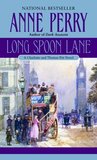
Mystery Review (DNF): 'Long Spoon Lane' by Anne Perry

Long Spoon Lane

If I’d known going in that this was the twenty-fourth book in this particular series, perhaps I might have expected some problems. But it was a book group read, recommended by one of the members, and it seemed to be right up my alley – a murder mystery set in Victorian times. Well, that sounds like fun, doesn’t it? Something light and entertaining, but with a more interesting background than the usual inner-city fare or the Marple-esque twee rural village beloved of the writers of cosy mysteries.

But all that backstory inevitably cast a pall over proceedings. This is not the sort of series where everything resets at the end of each book. It’s clear that there have been years (perhaps decades) of interaction between most of the principle characters. To say they have history doesn’t begin to cover it. To be fair, the author fills in the details pretty well, and it wasn’t too confusing. The problem was that the earlier events sounded so much more interesting than this book. The lead character’s wife, Charlotte, for instance, and her sister Emily, who are nothing more than domestic goddesses in this book, appear in some earlier existence to have done a great deal of sleuthing on their own account. Now that’s a book I would willingly read.

Then there was the subject matter of this particular story, which revolves around anarchists, corruption in the police force and a plan to introduce laws to allow the police to be armed and to have greater powers in their investigations. Since it’s well known that the British police are not routinely armed to this day, there’s no dramatic tension in that particular plot line. It seems to be merely a platform for the author to express her own views through the characters, who hold endless worried conversations about how dreadful such a step would be, and blah blah blah. Yes, yes, but it gets old very quickly.

None of this would have mattered if the plot had ripped along or the dialogue sparkled or the characters were lively, but sadly, it was not so. After the initial excitement of bombings and shootings (where our hero Pitt repeatedly displays his over-sensitive horror at such dreadful goings on in England), the plot settles into a rather dull political affair. The writing style is loosely in the manner of Victorian novelists, although with intrusive diversions to explain subtleties of social propriety which the reader is (presumably) too stupid to understand otherwise. None of the characters really came alive for me, but perhaps they were constrained by the formality of the era. There were moments where the author captured the atmosphere of London in a truly evocative way – the scenes beside the river, for instance – but mostly the writing was workmanlike rather than compelling.

I suspect that the earlier books in the series were much more readable. This felt like a tired effort, where the author had run out of ideas and possibly even interest in the series, but was soldiering on in the interests of fan satisfaction. No doubt those who’ve read the preceding 23 books will love this one, but it wasn’t for me. I got to 30% before I gave up on it. One star for a DNF.

Sunday, 20 April 2014

Fantasy Romance Review: 'Sarya's Song' by Kyra Halland

Sarya's Song

Wouldn’t it be lovely if you could compose a song which would guarantee good weather or bountiful harvests or a cure for illness? That’s the premise here, and what an enchanting one it is. The creator god made the world and left a series of specific tunes (‘tropes’) which allow the humans to control their environment and live in peace and plenty. The god has moved on to other worlds but the tropes should carry on working indefinitely – except that something is going wrong. Harvests fail, epidemics break out, the weather has turned nasty and no one knows why.

Sarya is a part of this magical-music world, having both a True Voice (one which can affect things by singing) and being also a trained Arranger, someone who takes the required tropes and combines them into an effective choral arrangement. Inevitably (this is fantasy, after all), she’s an orphan with a rough past, whereas most of the people at the Skola (musical academy) are upper class and wealthy, so she has had trouble being accepted into the community. But when one of her arrangements goes disastrously wrong, Sarya is determined to find out why and begins researching the strange tropes which accompany the disasters.

From here on, the plot accelerates at a dizzying speed, and this part of the book is perfectly judged, with each success followed by a greater failure, and Sarya forced into more and more difficult decisions. There are some darker passages towards the end, but I didn’t find them too unsettling, and I liked the mature way the author handled the consequences of traumatic experiences. There were a few credibility issues, where I expected greater opposition to Sarya’s proposals, but in the end people just said, ‘Oh, all right then.’ And Sarya’s conviction that love interest Adan couldn’t possibly love her despite all the evidence to the contrary was not terribly believable. I mean, that passionate kiss should have been a bit of a clue, right? But the action rolled on unstoppably, and every crisis was page-turningly dramatic. This was a book that was hard to put down, and although there was nothing wildly original in the way events played out, it was still an exciting read.

Fantasy romance (or romance in a fantasy setting) is a difficult genre to pull off. It’s hard to get the perfect balance without one aspect swamping the other, but the author has done a terrific job here. The world-building is not extensive, since almost all the action takes place within the city of Sucevita, indeed within the Skola, but other areas are mentioned sufficiently to give the setting a feeling of real depth, both of geography and history. The religion, based around the magical tropes, is also well-conceived. The romance happily avoids the insta-lust and triangle clichés, and is enjoyably satisfying without ever overwhelming the action.

If there is a weakness to the book, it lies with the characters. Sarya is too impossibly altruistic and self-effacing and robustly determined to do the right thing no matter the personal cost, and the angst factor is quite high in consequence. Adan is too impossibly noble and generous and self-sacrificing and understanding. He’s also impossibly handsome and well-honed and a perfect specimen of manhood, but that’s par for the course for this kind of story, and I’m certainly not going to complain about it. Both main characters have their frailties, of course, but these pale beside their vast array of virtues. The other characters fall neatly into the good guys/bad guys duality, without too many distinguishing characteristics.

These are very minor quibbles however. On the plus side, the villain was chillingly evil, and one of the highlights of the book for me. His meetings with Sarya were wonderfully mysterious, and I enjoyed the way his true intentions were concealed until the last possible moment. Sarya’s past also gives her some depth, and the moment when she overcomes her history and gives herself unreservedly to Adan is a lovely piece of writing.

This was a very enjoyable read, a perfect blend of well-thought-out fantasy with a satisfying romance. I loved the ingenious and cleverly implemented concept of music as a form of magic. Highly recommended. A good four stars.

View all my reviews

Saturday, 19 April 2014

Mystery Review: 'Charity Begins With Murder' by Annie McDowall

Charity Begins with Murder

This is a quirky little book, filled with eccentric characters who are nevertheless completely believable, reacting to an increasingly dramatic sequence of events exactly as you would expect normal people to react. The first response to new information or a threat is always ‘let’s tell the police’ instead of the all-too-common policy in amateur sleuth stories of attempting to deal with everything single-handedly.

The plot: Nikki is out of work and depressed after a traumatic event at a previous job, forced back into work by the government’s ruthless program to reduce the unemployment numbers. She reluctantly takes a job as receptionist for a charity in a seedy part of London, where her boss dies in the middle of a meeting on Nikki’s first day at work. And from there onwards, things get steadily worse.

Nikki is a fairly likeable character, and her friends are an entertaining bunch. I don’t know London very well (I live at the other end of the country) but I did wonder how realistic it was to find quite so many gay, black/coloured, disabled and otherwise minority groups in an area who were all such cheerfully nice people, while the middle-class white folks were – well, less nice, in many cases, and downright creepy and villainous in some. It seemed a little like inverse type-casting. In my experience you find good, bad and downright weird in all ethnicities, and always more good than bad. I was half hoping that one of the minority characters would turn out to be a villain or at least pilfering the coffee money, just to redress the balance a bit, but no.

The early chapters were a little slow, and it took forever to determine that the initial death was indeed murder and not merely a tragic accident, which was frustrating given the book’s title. After that, the story unfolds very nicely, and winds up to fever pitch at just the right moment, although the reveals weren’t terribly surprising. The book is easy to read, although the author likes to detail every little part of each conversation, however banal. I’d have preferred a little more snappiness, but that’s just me.

I found the romance element a little too dominant for this kind of plot where the murder should be the main feature – and no, that’s not just because it involved a lesbian love triangle. I thought the new romance was rather sweet and beautifully judged, but the old flame angle got a bit tedious after a while. Too much angsting for my taste. However, for anyone who dislikes gay characters, be warned: the main character and most of her friends are gay, the gay lifestyle dominates and there is some (tastefully done) sex.

An entertaining, if light-hearted, read, with some well-drawn characters and a good sprinkling of British humour. I would have liked a little more unpredictability and perhaps a tad less political soap-boxing. Three stars.

Thursday, 3 April 2014

Steampunk Review: 'Emperor's Edge' Short Stories by Lindsay Buroker


Ive been catching up with a few short reads these past few days, which does wonders for the tbr list. Theres not enough to say about these to justify a review each, so Ive gathered them into a compilation.

Shadows Over Innocence (Emperors Edge 0.5)

A nice little short story giving a glimpse into the background of Sicarius the emotionless assassin and Sespian the future Emperor as a child. One for the fans, and best read after some of the Emperor's Edge series to fully appreciate the nuances. Two stars.

Ice Cracker II and other stories (Emperors Edge 1.5)

The Frozen Water Trade, Through Fire Distilled, Ice Cracker II

These are fun, light-hearted reads which follow a similar formula: Amaranthe is going about her business when she stumbles across a dead body or an exploded machine, leading her to investigate, whereupon things get much, much worse. Two stories feature Sicarius, and one has Books in it (but sadly theres no sign of Maldynado). Three stars.

The Assassins Curse (Emperors Edge 2.5)

A nice spooky haunted island is the star attraction here. Amaranthe and Sicarius are training in the lake when they spot something odd going on. Can Amaranthe resist investigating? Of course not. This leads to an encounter with another of the authors ingenious steam-powered machines, and the usual implausible but entertaining fight scene. Three stars.

All of these are recommended for fans of the Emperors Edge series, although there isnt a whole lot of backstory revealed. Theyre also a pretty good introduction to the authors steampunk world and mayhem-and-explosion-rich style of adventure.

Sunday, 30 March 2014

Fantasy Review (DNF): Children of Sun and Moon by Matt Larkin

When I have a problem reading a book, it’s rarely the obvious things that bother me. Well, bad grammar and spelling, of course, but that’s usually glaringly obvious within a couple of pages, so it’s easy to avoid. Cardboard characters, trite plots, over-reliance on action, poor dialogue, info-dumps – I might criticise a book for these flaws but they rarely cause me to give up on it. No, what does it for me is implausibility. It’s ironic, in a genre like fantasy that is absolutely dependent on arcane powers, creatures and entire worlds that don’t (and can’t) exist. I’m quite happy to read about wizards and elves and dragons and all sorts of whatchamacallits, but show me an inconsistency and I’m likely to toss the book against the wall. And so it is with this one.

First, the good stuff. The world-building here is awesome, without qualification. The setting is eastern, with sarongs and teahouses and satay and forms of martial arts, and that’s all very cool. It never feels derivative, though, because there’s a very ingenious magic system based around the moon and sun. One society in this world (known as Skyfall) worships and derives power from the moon, the other from the sun. Rather neatly, those powers are very fitting: the moon powers, if overused, cause the user to go mad (lunatic, get it?); sun power users can move instantaneously, like a sunbeam. It’s all very well thought out. There are some good action scenes, which are very well described, and the Lunar and Solar powers give these an unusual twist. There are some interesting characters, particularly Marin the... well, not sure what he was. Were-tiger?

Now for some so-so stuff. The settings are never very well described. The Solar people live in an amazing crystal underwater city, and I really wanted to spend some time just walking around such an unusual place to get a feel for it. Sadly the plot races on, so there’s never a chance to linger. Then there are the characters. Chandi, the female main character, starts the book by helping to kill her betrothed. Yet she moves on from that with scarcely a thought about him, and he’s quickly forgotten altogether. Ratna is another important female character, the daughter of the Lunar leader, married off to the Solar Emperor to cement a tenuous peace. I really wanted to know how she felt about that, how she got on with her husband, whether she felt used or betrayed. Yet she seemed very unemotional and accepting about it. I’d have liked to get to know the Emperor, too.

And then the problems. A number of things happen without sensible reasons. By sensible, I mean things that make sense within the world. Obviously authors can make up whatever rules they want for their worlds, but internal consistency is paramount. Here are some examples that failed for me. In the very first chapter, a Lunar character has over-used his powers and gone mad (lunatic). Chandi reports him and is sent off to kill him. But she is weaker in combat than he is, and only outside help manages to do the job. Since lunacy is a well-recognised problem, with a standard penalty (execution) it makes no sense to use one-on-one combat to carry it out. The state would surely have devised a more appropriate legal arrangement (with a trial, possibly? Just a suggestion). The fight makes for a great scene, but it’s quite illogical.

Another example. When Chandi and Ratna arrive at the Solar capital, they are greeted by Naresh (the male main character), riding some kind of sea monster. But he isn’t a member of the elite guard who usually do this, and someone else has to control the monster for him. Why then was he sent? The only reason is that the author needed to introduce him into the story.

Yet another example. Ratna, now the Emperor’s wife, wants to take her child to watch some celebration. The pair set off through the crowded city escorted only by Naresh and Chandi (who spend the whole time studiously pretending they’re not going to end up together by the end of the book). And the city isn’t friendly, since there was a previous assassination attempt. No, I don’t think so. Two of the most important people in the city, just wandering round in the crowd? Two people who, if killed, would precipitate a war?

This was the point where I gave up. For those who aren’t bothered by this and don’t mind the rather episodic and jerky telling of the story, this is an interesting attempt at something out of the ordinary. I got 20% of the way through, and it may be that some of the issues mentioned are addressed later in the book. It just didn’t work for me, however. One star for a DNF.

Saturday, 29 March 2014

Steampunk Review: 'Beneath The Surface' by Lindsay Buroker

Beneath the Surface (The Emperor's Edge, #5.5)

This is part of the Emperor’s Edge series, a novella that fits squarely between part 5, ‘Blood and Betrayal’, and the two-part finale, ‘Forged in Blood’. Those who’ve read any of the series will know exactly what to expect: seemingly small events rapidly escalate into madcap chaos, increasingly impossible-to-get-out-of situations and an implausible number of fights, explosions, wrecked vehicles and other general mayhem. Given the inventive steampunk setting, mixed with some more advanced technology (post-apocalypse? or alien? not sure, but it doesn’t really matter), the series is an entertaining riot, where the reader simply can’t imagine what might be round the next corner.

Or perhaps I should say: what’s round the next bend in the river, because for this outing the team is aboard a paddle steamer, leading inevitably to equipment and people splashing overboard, diving into cabins to avoid being seen, climbing between decks by hopping over railings and hiding away in funnels. Oh, you didn’t think hiding in funnels was inevitable in fantasy? Well, in a Buroker novel, expect the unexpected (and you’d be surprised what characters can get up to while suspended inside a funnel – well, I was surprised).

The characters are, as always, the high spot of the book. However serious and potentially fatal the situation, former Enforcer Amaranthe’s unlikely bunch of heroes can be depended upon to carry on sniping playfully at each other and tossing out witty asides as they go. No matter how ludicrous the plot (and, let’s be honest, you just have to switch off the logical part of your brain altogether for this sort of caper), the jokes made me laugh out loud more times than I can remember. The author gets the tone just right, too. In the previous book, the way Amaranthe and iceman assassin Sicarius inched towards an understanding was note perfect. In this book, it’s Maldynardo who has his delicate little romance reach fruition and given Maldynardo’s constant flirting and outright skirt-chasing, the temptation to ham it up must have been almost irresistable. But no, every moment between Maldynardo and his lady was perfection. Beautifully judged.

For anyone who’s read the first five books in the series, this is the perfect palate-cleanser before the final course. If you liked the others, you’ll enjoy this one too. I liked that recaps of the previous books are dropped in effortlessly, so that I never had to struggle to remember what happened. And the background plot is warming up nicely. For me, the relentlessly ramped-up action gets a bit wearing after a while (I like my fantasy just a tad more realistic than that), but I have to admire the author’s ability to develop her characters and their relationships just enough to maintain interest while never losing sight of their basic personalities. A good three stars.

View all my reviews

Wednesday, 26 March 2014

Mystery Review: 'Gone Girl' by Gillian Flynn

What to say about a book that's been the focus of so much adulation, but also mystified a sizeable proportion of its readership? So many people say: I just don't get it, don't like it, can't read it. The problem is that the two main characters, Nick and Amy, are seriously unlikeable. Not just not-my-type unlikeable, either. This is one totally messed-up weird twisted wreckage of a couple. Well, unlikeable's never bothered me. Some of the most interesting characters are villains. Heroes and heroines tend to be bland and dull and boringly good; give me a good villain any day.

The other big problem to overcome is the writing style, which can best be described as over-the-top aren't-I-clever? Both main characters are written in first person, so there's ample opportunity for snide abuse by the bucketload. Maybe ten per cent of it is incisively funny, the rest varies from meh to eye-rollingly bad to downright offensive. I dislike that kind of look-at-me cleverness, but enough of it was funny to get by, and all of it was in character, so it's hard to object to, I suppose.

The plot is that Nick and Amy have been forced by the recession to move from their sleek Manhattan lifestyle to a more modest life in Nick's hometown in Missouri. They both find the change difficult, the marriage begins to fall apart and then, on their fifth wedding anniversary, Amy disappears, leaving a stagily disorganised house, cleaned-up bloodstains and a great deal of other incriminating evidence pointing straight to Nick as a likely murder suspect. Since we are inside Nick's head a lot of the time, we know there's more to it than it appears.

I don't want to say too much about how the plot develops, because there are more twists than a bag of pretzels, and I don't want to spoil the surprises. However, the main twist at the halfway point was one I saw coming almost from the start, which added some interest to the early part of the book. It's always fun to appreciate both the obvious surface viewpoint, and the inside perspective that illuminates the behind-the-scenes manipulation. After that reveal, the pace ramps up and this part was, for me, unputdownable.

And then the ending. Again, it's one I saw coming. It seemed almost inevitable, although I hoped right to the last minute that there would be some big twist to force things off in a more interesting direction. There was a small twist, I suppose, so the way in which the ending was achieved was unexpected, but the actual situation was as I'd foreseen. Sorry to be so cryptic, but I really don't want to spoil this for anyone.

For anyone looking for deeper meaning in a psychological thriller, there's interest in the way the whole story was handled in the public eye, on TV, on the internet, through talk shows and to-camera interviews. The police investigation was gradually overshadowed by the global media take-up of Nick and Amy's story, and the way they were manipulated by the various factions involved. This isn't a particularly original line to take, but it was handled well here.

Ultimately, even though I didn’t expect to, I'd have to admit I enjoyed this. The plotting was clever, the way the book was structured, with alternating Nick and Amy chapters, was clever, the writing was clever and sometimes downright witty. Even knowing where things were going much of the time, I was still on the edge of my seat at the way the plot screeched round corners and made abrupt u-turns. I'd have put this at four stars but the ending was disappointing in its lack of proper resolution. Leaving things in unstable and potentially explosive equilibrium isn't very satisfying, although perhaps it's appropriate. So three stars.

Tuesday, 18 March 2014

Mystery Review: 'Death in Spigg's Wood' by Linda Gruchy

This is an unusual little book, something of a courtroom drama crossed with a police procedural, with a slathering of thriller on top. The style is different, too. The main character, Meg, keeps a diary for some of the events, so there are sections written in first person. The bulk of the book, however, is in a very wide-angle third person point of view, leaping merrily from one character to another, sometimes only for a sentence or two. This does mean that absolutely no detail is left out of the story. The downside is that, although the changes are never confusing in themselves, it did leave open to question the matter of which characters were the most important. There were so many named police with active roles that I never did work out if any of them were meant to be main characters. It's so common these days to focus closely on just one, or perhaps two, main police characters that I found this broad-brush approach disconcerting.

The opening of the story is far more traditional, bordering on cliche. Middle-aged housewife Meg is caught by the police, gun in hand and with another in her pocket, with three seriously injured men. Despite her protestations that she came across two of the men beating up the third and was forced to defend herself, she is arrested. The story then follows all the twists and turns of the police investigation in great detail, the trail of evidence, the interviews, the reveals about Meg, the slow evolution of the theories and, in time, the court appearances.

In all of this, Meg is the most strongly drawn character by far. Partly this is because of those first person diary entries which help the reader identify with her, but the author also succeeds in capturing the wild mood swings Meg experiences. She veers from tearful self-pity, to violent anger, to depression and apathy in moments. I suppose only someone who's truly experienced something similar can say for sure, but I found this very believable.

The police, sadly, never quite come across as real individuals. This is probably because there were so many of them that I found it impossible to keep track of them all. They all blurred together in my mind. Towards the end, I did begin to disentangle one or two of them, but it was a little late by then. While I enjoyed the realism of the police investigation, it might have been better to sacrifice a little of that by merging some of the multitude of characters.

I don't usually comment on typos and the like, because I find that virtually all books have a sprinkling of them. Generally, it's only continuity errors and plot holes that really bother me, and that wasn't an issue here. However, there were innumerable small but annoying typos, like words missing or misplaced, that became quite irritating. However, I've had the book on my Kindle for a while, so it's possible it's been tidied up by now.

Where the book truly scores is in the tension. Even though the writing style is more dry reporting than melodrama, even though every little detail was included, I found the story totally compelling, and just couldn't put it down. It surprises me to write this, but the courtroom scenes were so tense I found it hard to remember to breathe, sometimes.

The ending was slightly jarring, and there were too many pages of explanation for my taste. However, there were some very interesting philosophical points raised. To the reader, rooting for the innocent Meg caught up quite by chance in extreme events, the black and white aspects of the case are completely clear. For the police, viewing the evidence dispassionately, and for the lawyers, judges and juries involved in the formalities of the law and seeing only a small part of that evidence, there are many shades of grey. An unusual tale, whose quirks never spoiled my enjoyment. If I had half stars available, this would be three and a half stars, but since I don’t let’s put it down as a very good three stars.

Friday, 14 March 2014

Fantasy Review: 'Blood Of The Land' by Martin Davey

This is a real curate's egg of a book. Some parts are awe-inspiringly well written, while other parts are frustratingly bad. It's clear that the author can write, in the sense of being able to craft a well-honed sentence. His ability to create compelling characters or describe his world thoroughly or simply tell a story that absorbs and mesmerises - these are in greater doubt.

The book opens well, with a vividly drawn event which surprises on many levels without being confusing. So far so good. In fact, for several chapters things go very smoothly, and I began to harbour high hopes that this would turn out to be one of those unsung gems, a little treasure unknown and unappreciated by the world at large. But then things began to go awry. The author has a penchant for spookiness that verges on horror, and this works pretty well in small doses, generating a nicely creepy atmosphere. However, it soon becomes clear that much of this spookiness is simply a means of concealing useful information. All too often, a conversation with a character who knows what's going on is so cryptic that nothing is revealed. Characters are told lies or nothing at all, are told to obey without question, are given arm-waving vagueness - it had me screaming with frustration. I get that authors love to withhold details for that big last-minute reveal, but readers do need some information dribbled out to them to keep them interested.

Then there are the characters. The story is told through three main point of view characters. Landros is an indifferent guard watching nothing very much (it seems) in a small town in a remote location. Ysola is an abused wife (yes, that old cliche) now returning to her home village which is mysteriously different from her memories. Marin is an aging warrior but despite that hackneyed description, he's still the most interesting of the three, for reasons I'll get to. To start with the three seem to be completely separate, and this gives the early parts of the story a disjointed air.

The world-building is intriguing. Several thousand years earlier, during a time of kings described as 'lustful', the nine gods decided to get rid of them and there was a war during which the kings were defeated, four of the gods were killed (curious but unexplained) and a Nameless One was also defeated. Since then, the remaining five gods have controlled a docile human population by 'calling' individuals to do certain things. An individual dreams of meeting one of the gods, who instructs them to take up a particular profession or (in Landros's case) to be promoted to Captain. This immediately raises the question: what happens if the individual refuses? It is Marin who answers it: he has been tortured by the vengeful god every night as he sleeps because he refused. What nasty gods.

But somehow, this interesting background never blossoms into a compelling story. The real problem, for me, was that the main characters are all completely passive. Things happen to them and around them and (sometimes) because of them, but they drift through all this like lifeless dolls, making no decisions, taking no action on their own account, simply being manipulated by events and by other people, without any overt sign of rational thought. When things happen, they fail to react in realistic ways. Sometimes they don’t respond at all. It’s as if they are merely observers at a play, walking around on the stage but simply glorified members of the audience. I’m not a big fan of the get-up-and-go all-action style of protagonist, but I do like a main character to be awake while the plot is unrolling on all sides.

Once I got past the halfway point, it became clear that, while the author may know perfectly well where the plot is going and why, I still didn’t have a clue. I struggled to the 60% point before giving up. I didn’t care about any of the characters, and the only remotely interesting one, Marin, had his most intriguing aspect entirely negated by something that happens to him (which I won’t give away, because it’s a bit of a shocker). The book lacked focus, and in places rambled and repeated itself. It could also have done with a thorough final edit to weed out innumerable small but irritating errors in punctuation and a few spelling and grammar typos.

This was a disappointing read. The underlying ideas are excellent, and the author displays a fine writing style much of the time. For those who like their fantasy deeply mysterious, and infused with a thick layer of horror, I can recommend this. Sadly, it just didn’t work for me. One star for a DNF.

Tuesday, 11 March 2014

Romantic Mystery Review: 'Wounded' by Lindsay Buroker

The author describes this as a rom-com, and that's as good a description as any. It's superficially an action mystery, but the romance is the core of it and also the part that works most effectively. If I tell you that the mystery part involves ruthless and evil - erm, mushroom researchers who’ll stop at nothing to get their hands on a particularly rare specimen which will cure antibiotic resistent TB, you'll probably get the point.

The plot (such as it is) involves heroine Tara making a temporary stay at an eco-village to produce blog material for a local newspaper. She arrives in the middle of a dispute with a neighbour involving escaped pigs and decapitated chickens. The neighbour, naturally, is a hunky heap of muscular maleness, called Malcolm (after the Scottish king; hurray for Scottish kings!). Tara manages to exploit her blogging and website building skills to impress said hunky heap, but thereby finds herself sucked into the ongoing adventures, which involves much racing around hillsides in the dark, climbing out of bathroom windows and the like, while the hunky heap manages to get his shirt off at frequent intervals.

All this is fun if not terribly surprising. Nor is Tara herself a particularly plausible character. Although she's smart enough to set up websites in the blink of an eye, she's apparently not smart enough to bring along anything useful on a police-evading night-time chase, even when she stops at her own house along the way. Plus she trips over every tree-root in the state, seemingly, and ends up face down in the mud. I have to confess, I like just a tad more competence in a main character.

As for the hunky heap, he's got demons from his past to deal with, and, wouldn't you just know it, the climax of the book involves him having to face up to those demons. I realise there's a school of thought that requires characters to move forwards during the course of the story, making visible progress in the demons department, but frankly this was all just too contrived for my liking. A little more subtlety would have helped.

On the other side of the coin, the romance works really well. The banter between the two main characters is brilliant, and there are some very funny moments along the way. It amuses me to consider the research the author must have carried out for this book, covering (among other things) hallucinogenic mushrooms, pipe bombs and the feasibility of operating a mobile phone using only your nose (and I'd have paid good money to watch the experimentation on that one). Apart from Tara's tree-root incompetence, the two main characters are well drawn. The gradual inching from deep suspicion through grudging tolerance to tentative trust and the inevitable romantic entanglement is perfectly judged, and completely credible. For anyone who likes their romance sweet rather than hot, with plenty of light-hearted action and a great big dollop of humour, this is ideal. Three stars.

Friday, 28 February 2014

Fantasy Review: 'Dreamlander' by K M Weiland

It’s such a lovely idea: you fall asleep and your dreams are actually about another world. And just a few special people are Gifted: able to move between the two worlds physically. So this is a portal story, one of those tales with a dull, modern-day section which then shifts in an instant into a far more interesting fantasy world with swords and whatnot. The twist here is that every time the main character falls asleep in the interesting fantasy world – bam, he’s back in the dull modern world.

The fantasy world is not the most complicated ever. The map gives it away. There are a few rivers and hills, a sprinkling of cities, a castle and – erm, that’s about it. And no, dropping in phrases like ‘a white fillet of summerton and a peeled sopple floating in its bowl of sweet craniss wine’ doesn’t give it a more authentic depth. However, it does have a slightly steampunk air, with pistols and a steam-powered cable-car for long distance travel, which is quite cool. But (phew!) there are still swords and horse-riding soldiers who gallop into battle. So that’s all right then. Sadly, the modern world is every bit as dull as it usually is.

So here’s the plot. Every once in a while, a Gifted turns up who can cross freely between the two worlds. The last one was a total disaster, so when Chris finds himself the latest Gifted, he’s not exactly welcomed with open arms. The king just wants him to keep out of the way of the coming war. The religious fanatics want to use him as an excuse for trouble. The Searcher, the king’s daughter Alarra, has unresolved issues because of her failure to manage the previous Gifted. And as soon as he arrives in parallel world Lael, Chris is manipulated into bringing war-mongering Mactalde across from the modern world, thereby creating a tear in the space-time continuum. Or something. Something bad, anyway, since it makes the weather deteriorate.

The characters are the usual thing. Feisty independent princess. Check. Brave but sensitive manly type. Check. Stalwart, fiercely loyal old retainer. Check. Heroic but tormented warrior-type. Check. Evil villain. Oh yes. Amusing and/or irritating sidekicks. Check. Check. Check. There’s also a talking winged beast of some sort, who is supposed to keep the important characters informed but actually withholds vital information for his own (presumably plot-related) reasons. Which is terribly convenient.

Now, the author has done a good job of giving all the characters strong background stories, but this does rather substitute for actual characterisation. Stripping away the layers of guilt and fear and anger and betrayal around them leaves not much more than the bald stereotypes mentioned above. And then they will angst about it endlessly. I’m not a big fan of angsty characters, and, to be honest, I got a bit cross with them here. Chris, for instance, is weighed down with guilt because he brought Mactalde back, but since no one told him the truth, how was he supposed to know? And Allara is weighed down with guilt because she failed with the previous Gifted. Ye gods, she was nine years old at the time, being advised by a winged beastie who makes the Sphinx look like a model of clarity. Guys, it wasn’t your fault, OK?

I confess to having problems with the logic behind the basic premise. Yes, I know, magic... duh. But still, it should make some sort of sense. So we have these dual worlds, each one the dream world of the other. And the same people exist in both worlds. They do different jobs, but they’re the same people. You can die in one but your doppelganger lives on. So that boggled my mind right away. Then there’s the whole dreams business. You fall asleep in one and you wake up in the other? But... but... most people don’t sleep more than eight or so hours a day, so you get eight hours’ sleep in one world, eight hours in the other and... what happens to the other eight? OK, so I may be overthinking this, and to be fair Chris does seem to sleep a lot, in one world or the other, so I guess it works out.

A more serious problem is that the characters do really stupid things. I’ve already mentioned that Chris was manipulated into bringing Mactalde back, and I don’t totally blame him for that, but when some people are saying, ‘Yes, yes, do it, it’ll totally fix everything” and others are saying, “This is a really, really bad idea”, it might be smart to ask a few more questions, don’t you think? And thereafter the guy is constantly leaping into his horse or one of the cool skycar thingies to rush into battle or rescue people who’ve been given up for dead. In fact, the whole bang lot of them are prone to the horse-leaping and rushing and rescuing thing, including the king’s entire family. Well, it shifts the plot along, I suppose. But then the guy who betrayed them sends a message that he has some useful information, but Chris has meet him alone... I mean really, who is stupid enough to do that? Well, Chris, apparently. Doh.

Now if all this sounds as if I didn’t like the book, actually, I did, on the whole. It was entertaining and readable in a lightweight way, and for a bit of easily-digested fluff it’s very effective. As long as you don’t think too hard about it, it all works very well. By the middle of the book, it had settled down into a nicely paced, if over dramatic, tale. Latterly it degenerated into one of those we’re-all-doomed-we’re-saved!-oh-no-we’re-all-doomed see-saws, with our heroes implausibly surviving every tricky moment while the baddies are constantly two steps ahead. Which was, in places, eye-rollingly silly. But then came the ending, one of those unexpected moments when the author takes the mature, difficult, but obviously logical road. I love it when that happens. So kudos to the author, and extra brownie points. Recommended for anyone who likes relentless action and is able to switch off the but-but-why? side of their brain. Three stars.

Sunday, 23 February 2014

Fiction Review: 'The Mayor of Casterbridge' by Thomas Hardy

My book group has a sadistic streak. They recommend chick lit and Booker prize winners and other deeply worthy stuff, and turn their noses up at perfectly good fantasy. Why? I can’t understand it. ‘Wolf Hall’ would have been so much better with dragons in it (everything’s better with dragons). And here’s another of their good ideas: let’s do a proper classic. Now, I’d struggled with Hardy at school, but that was a long time ago. Surely it will be better now, with my greater maturity. So here’s the opening paragraph and a bit:

“One evening of late summer, before the nineteenth century had reached one-third of its span, a young man and woman, the latter carrying a child, were approaching the large village of Weydon-Priors, in Upper Wessex, on foot. They were plainly but not ill clad, though the thick hoar of dust which had accumulated on their shoes and garments from an obviously long journey lent a disadvantageous shabbiness to their appearance just now.

The man was of fine figure, swarthy, and stern in aspect; and he showed in profile a facial angle so slightly inclined as to be almost perpendicular. He wore a short jacket of brown corduroy, newer than the remainder of his suit, which was a fustian waistcoat with white horn buttons, breeches of the same, tanned leggings, and a straw hat overlaid with black glazed canvas....”


Right. This is going to need a lot of wine.

Now, the language is (not surprisingly) old-fashioned, since it was written in 1886. It’s not that difficult to follow, but it isn’t as readable as Jane Austen, who wrote more than half a century earlier. It’s quite dull, however, for a great deal of it is focused on turgid descriptions of the scenery. I know Hardy is famous for his poetic descriptions, but it’s that heavy mid-Victorian poetry that’s very much an acquired taste. And I haven’t acquired it.

Beneath the verbiage, there’s an interesting plot going on. A man gets drunk at a fair and sells his wife and child to a passing sailor for five guineas. Twenty years later, when he’s the eponymous mayor, the wife and daughter return. In the meantime, the man has had a liaison with another woman and promised to marry her, and when the wife dies she, too, turns up. To make the romantic entanglements complete, there’s a bright young Scotsman who becomes the mayor’s protégé, then falls out with him, and attracts both the daughter and the mistress. And that’s enough plot.

There are enough complications there to keep the average soap opera going for years. The most appealing aspect, to me, is that all the characters are well-meaning and trying very hard to do the right thing. They may make mistakes, but they do everything they can to correct them. The mayor agrees at once to court and re-marry his original wife. The wife agrees to it. The daughter, when she finds out the truth, goes along with it. The mistress agrees that’s the best thing to do. There are no villains here.

On the minus side, a great deal depends on coincidence. Important information is overheard. Secret letters are found. Characters fortuitously bump into other characters. Characters believed to be dead miraculously reappear. This all becomes terribly silly and quite incredible. Then there are the hordes of comedic yokels, wheeled out for a bit of local colour and stupidity from time to time. Combined with the heavy prose, this all became a bit much, and I gave it up at the 50% point. But the nice thing about dead authors is that their books are described in detail on Wikipedia, so I could read the entire plot without feeling I’ve missed anything (other than the comedic yokels, of course). One star for a DNF.

Saturday, 22 February 2014

Fantasy Review: 'The Splintered Eye' by H Anthe Davis

How do you follow off-the-scale awesomeness? There’s only one way – with a shed-load more awesomeness, that’s how, with a dollop of awesome sauce on top. I love this series. After ‘The Light of Kerrindryr’s tight focus on Guardian-carrying Cob and his escape from slavery, this time the camera pans back a little to show the devious machinations at the heart of the empire. And there’s a quest! Yay for quests!

I raved about ‘The Light of Kerrindryr’, rating it my second favourite read of 2013, but that always makes me nervous about reading the follow-on. I needn’t have worried. The author’s trademark elegant writing style, vivid visual imagery and endlessly inventive imagination are all present and correct. And the characters come to life in ways that many popular writers could only envy. Cob is still his grumpy self, but he handles his anger-management issues better here as he gradually comes to terms with the Guardian (and pals) lurking inside him. Cob in full-on Guardian mode is still an awe-inspiring, if slightly worrying, sight. But Cob is no longer alone. He has collected possibly the most mismatched group of characters ever seen in fantasy – a wolf shape-shifter, a wraith, a religious warrior, a shadowlander and – well, whatever Dasira is.

And Cob finally gets him a little loving. Not the world’s most earth-shattering romance, perhaps, and I wonder slightly at the lady’s motives, but it’s still nice to see Cob growing up a little and enjoying himself. I would have liked a little more detail of the event itself, because such an important moment in a character’s life justifies some exploration, but that’s just me. The fade-to-black made it feel more perfunctory than perhaps it would have been for Cob.

Of the other characters, I loved Arik the wolf-man, who acts like an excitable puppy around Cob. Even when he’s in human form, the author never lets us forget his wolfish side, so his movements, his thoughts, the scents he’s constantly aware of are all completely animal-like. Fiora the religious warrior-babe is less likeable, to me, because I was never completely convinced that Cob’s welfare was her sole objective. But I have to admit that she’s a handy girl to have at your side in battle, and being able to summon godly power at will is a useful ability.

All the rest of the vast array of characters populating these lands are complex, fully rounded personalities, all with their own agendas – boy, do they have agendas. The political nuances are such that the reader can never be totally sure who is on which side, or (more likely) playing both sides against the middle. And who would have guessed that seemingly out-and-out villains like Kelturin and Enkhaelen could be made so distressingly sympathetic? My heart bled for both of them. For the ultimate in complicated motivations, there is Dasira, a character with a jaw-dropping history. It’s probably perverse of me, but I was half-hoping that Cob’s romantic tendencies would lean that way, because – well, just because. Maybe as well they didn’t.

The author has one habit which is almost unavoidable in a series as epic as this, namely, switching point of view frequently. I hate the Game of Thrones technique of assigning point of view by chapter; there’s nothing more dispiriting than finishing a Tyrion chapter and turning the page to find it’s Catelyn next. Fortunately, here the point of view sections are as long or short as they need to be, and sometimes a character is wheeled on briefly just to reveal a key piece of information. This strategy makes the transitions as painless as is humanly possible, and never disrupts the flow of the story. I found, too, that there was no equivalent of Catelyn, a character who made my heart sink every time she appeared. All the characters here are interesting enough to carry their own sections effortlessly.

If you like your world-building industrial strength, this is the series for you. There are countries, races, religious systems, ecologies, languages – everything worked out to the last decimal place. Magic? Oh, yes, loads of it. Now I don’t pretend for one moment to have followed all the subtleties, but I was never out of my depth, either. There were no more than a couple of places where I didn’t get a reference. Mostly everything was beautifully clear or else (like some of the details of dress and so on) added colour without slowing things down. I never felt the need to take notes to keep up, never had to struggle to remember what happened in the last book, never got distracted by extraneous side-issues. This world always felt completely real, and not merely a sketched-in backdrop for the action.

And what action it is. There is a lot going on in this book, not just with Cob and his disparate band, but in the imperial army, amongst the wraithy-types, and (oh joy!) at the imperial palace, which is weirder than I’d have believed possible. And then there’s the Emperor. No wonder there are some peculiar things afoot in the empire. As with the first book, there are also sequences that are maybe dreams or hallucinations or other states of not-realness, or perhaps not-of-this-worldness. This elision between real and ‘other’ is one of the most fascinating aspects of the story.

There’s a touch of middle-book-itis in some aspects of the story. Iskaen and Rian are not much more than tokens, promises of some wonderful clashes to come (and Rian’s one of my favourite characters, who surely deserves his own spin-off series). Sarovy’s role is modest in this book, which is a slight disappointment to me, as he’s another favourite, with his ultra-strict and unquestioning adherence to the rules. Nevertheless, they still get scenes of unforgettable power. The moment when Sarovy’s ‘specialists’ reveal their true natures is one that will stay with me for a long time.

And this is, ultimately, the author’s greatest strength. It’s not just the amazing world-building or the complex and layered characters or even the plot that sweeps me off my feet. It’s these moments of vividly-drawn images – Kelturin before the Emperor, the battle at the crystal tower, the escape from the blood-red plant-life of Haaraka, Cob in full-on not-really-human mode powering through the wintry landscape, Enkhaelen painstakingly mending bodies, Cob learning to fight, Cob (again) at Enkhaelen’s house. It’s these powerful moments, balancing on the edge between fantasy and a kind of spine-chilling horror, that lift the book way above the average fantasy saga. And if you want layers of meaning, about reality and dreams and truth... that’s all there too.

I don’t often recommend books. Mostly I say: here’s what worked for me, and here’s what didn’t, and you can decide for yourself. But this is a book, or indeed a series, that deserves a wider audience than it’s likely to get. It should be on bestseller lists and winning awards. It should have a horde of excitable fans lovingly compiling Wikis, wearing cosplay antlers and endlessly debating the nuanced differences between airahenes and haelhenes. So just go out and buy it, OK? It’s piking awesome. Five stars.

Sunday, 9 February 2014

Sci-Fi Review: 'The End Specialist' by Drew Magary

The best speculative fiction takes a what-if? scenario and then explores the possible consequences of that idea. This book certainly does that. It proposes that a cure for aging is found, a process which stops the body's natural senescence so that a person using it remains forever at the same physical age. They may still die of disease or violence or accident, but the body won't age.

The book attempts to follow the progress of societies post-cure by means of a journal, a time-honoured technique which can work quite well. Here, however, the author uses it to shoehorn in every little bit of speculation about the consequences that he can think of, sometimes in only a few lines, bullet-point style. To say that this makes the book disjointed would be an understatement. It would have been far better, I feel, to focus more tightly on the main character, John, and make it truly personal. Taking a chapter to describe the problems of a character in China, where the cure was banned, based tenuously on the idea that John once knew him, doesn't serve to connect the reader with those problems.

The pseudo-journal follows John's life as society gradually adapts (or rather, fails to adapt) to increasing numbers of people who don't grow old and die. The author tries to demonstrate the various approaches taken by individuals and governments, but it really covers too much ground to make an interesting story. Some aspects worked well, for instance, the changes in technology are never explained, they simply pop up in references to plug-ins and WEPS, used as if the reader is perfectly familiar with them. It became fun trying to work them out. Other aspects, like an outbreak of 'sheep flu' are described in detail, as in a news report, and this was more tedious.

For anyone who likes to watch the apocalypse unfolding, slowly, over several generations, this book might do the trick. It's been nominated for a number of awards so clearly its unusual storytelling technique is appreciated in critical quarters. For me, though, it failed at the most basic level, in not giving me any characters I could connect with, and breaking the story into dozens of disjointed chunks. Two stars.

Fiction Review: 'Stonemouth' by Iain Banks

This is one of those odd books that I found enjoyable to read at the time, but when I put it down, I lapsed into so-what? apathy. The premise is a fairly trite one. A mid-twenties man returns to his childhood home for a funeral, and spends the time reminiscing about growing up, being astonished at the changes that have taken place and equally astonished at the things that remain unchanged, and resolving a few loose ends from his departure five years before. So far, so ho-hum. The twist here is that the setting is a small town set in the northeast of Scotland, ruled in relative calm by two gangster families, and our hero was run out of town after almost marrying the daughter of one family.

The setting was one of the attractions for me. I live less than two hours' drive from the supposed location of the town of Stonemouth, and many of the descriptions of the beaches, forests and streets rang very true. Banks' descriptive prose is wonderfully lyrical, and captured the atmosphere beautifully. It was a little disconcerting that a major road bridge played a prominent role in the story; there are so few of those up here, that I kept visualising it as one of the known bridges - the Kessock bridge was my personal mental image - which pulled the book's geography out of alignment, as if the map was stretched out of true.

The childhood reminiscences worked less well. Some were funny and some were tragic but none of them really tore at my heart as perhaps they should have done. Some of main character Stewart's friends were, frankly, too stupid for words. The book interleaves the present-day events with vignettes from the past in order to keep hidden a couple of mysteries: what Stewart did to get him run out of town, and what really happened to the brother of his almost-wife? These were enough to keep me turning the pages, so they worked as intended, but frankly the revelations weren't particularly mind-blowing.

Stewart himself is rather a nothing character. He seems fairly blank, rarely expressing any emotion other than fear, although his continuing affection for almost-wife Ellie is rather touching. Of the others, Ferg the sardonic bisexual is far and away the most interesting. I'd have been happy reading an entire book about him, actually. The rest were either caricatures (Ellie's thuggish brothers, the stupid friends) or nonentities (like Ellie herself, drifting aimlessly through life), although Ellie's younger sister Grier probably rates a mention as having slightly more personality.

The final chapters are melodramatic, which seems to be obligatory these days, and the story then tailspins off into an implausible resolution for the main characters. The plot also fails one of my favourite tests: could most of the plot be resolved if the principals simply sat down and talked everything through? In this case, it was a puzzle to me why Ellie, in particular, didn't say to her family: I'll decide my own future, thank you very much. As she does, in fact, later on. The plot hinges on her being the sort of person who allows herself to be pushed around, but only until the plot requires her to push back. So that was a big fail, as far as I'm concerned. Three stars.

Sunday, 26 January 2014

Fantasy Review: 'The Nullification Engine' by Scott Marlowe

This is the second book the Alchemancer series, following on from ‘The Five Elements’. Like that one, this starts with a bang, literally, a mysterious underground explosion in the city of Brighton, just as our heroes from the first book, Aaron, Serena and Ensel Rhe, arrive there, followed almost immediately by demon houndmaster Krosus and his evil pack. In dealing with the hounds, Aaron and Serena manage to get themselves arrested and tossed into the dungeon. It has to be said, the author knows how to drop straight into the action.

After this, the pace lets up just a little, and branches out into multiple point of view threads to ensure that the plot is nicely stirred. There’s the airship which featured in the first book, newly arrived for repairs; there’s a King’s Patroller, whose function I’m not sure about, but he seems to be a good guy; there’s a disgruntled pyromancer; there’s a dwarf underworld boss with a beautiful daughter; there’s an old enemy of Ensel Rhe’s; and there’s a nest of rats-on-steroids under the city, who wear clothes and wield swords and are definitely bad guys. Well, they eat people. Oh, and there’s a machine, the Nullification Engine of the title, which is seriously cool and I can’t wait for the movie to be made to see exactly what it looks like.

Of the characters, Ensel Rhe is the most interesting, with his mysterious past and his super-ninja skills. In the first book, he was rather lightly sketched in, more plot device than rounded character, but here he gets a lot more screen-time and a chance to shine. Every scene he was in sizzled with tension. We learn quite a bit more about him here, which only serves to make him more intriguing. Aaron, the prodigy applying logic and science to largely magical artifacts, is also fun, and I loved the way he cracked the code. Serena worked less well for me. Her conventional upper-class family setting did nothing to make her interesting (to me), and there were times when she simply acted in ways that had me rolling my eyes. Speaking up at the funeral, for instance, and only realising afterwards that it might be a Bad Idea. And when her former mentor tells her to stay away from a device, what is the very first thing she does? Doh.

Of the other characters, they’re nicely drawn and work very well. I particularly liked the newly introduced Jakinda, a nice fiery character. I’m very much looking forward to seeing her in action in the next book. The dwarves were huge fun, too, although why is it dwarves are always the comic relief? I blame Peter Jackson. But the star character for me (if I can describe it this way) was the Nullification Engine itself, which stole the show in every scene it was in, and was a wonderfully unpredictable and fascinating device.

As with the first book, the plot rattles along at a breath-taking pace, with an unpredictable twist in almost every chapter. If I had a beer for every time I muttered ‘Didn’t see THAT coming’ I’d be blind drunk under the table by now. My only complaint is that I had trouble remembering everything that had happened in the first book, so I was flummoxed for a while when certain characters turned up again. A summary would have helped, although to be perfectly fair, I’m very bad at remembering plots in general, so I have the same trouble with every series. In other words, my fault, not the author’s. There’s a list of characters at the front and some good maps, too, as well as a sprinkle of reminders throughout the story, so I got past the confusion stage in the end. There was one plot-thread that I didn’t fully understand, involving Krosus the demon houndmaster and Ursool the witch; I’m still not sure just how things ended up there, but again, I suspect it’s just me not paying attention, since everything else was tied up beautifully, with neat little bows on top.

Another fun read, very entertaining, with a great ending setting everything up nicely for the next book. Highly recommended. Four stars.

Friday, 17 January 2014

Fiction Review: 'Look At Me' by Jennifer Egan


In honour of my new resolution to toss anything that doesnt grab me in the first 10% or so, heres another DNF. Now Im sure this is a deeply worthy affair, covering the themes of identity, how others see us and how we see ourselves. Its well-written and all that. But it lacked something. Plot, mainly. Interesting characters, definitely. Any kind of impetus to keep turning the pages, or to find out what happens to these people. I just didnt care.

It started so well, too. This is the opening:

After the accident, I became less visible. I dont mean in the obvious sense that I went to fewer parties and retreated from general view. Or not just that. I mean that after the accident, I became more difficult to see.

Now, thats intriguing. How did she become more difficult to see? Or rather, why? I felt a frisson of interest. Was there, perhaps, some paranormal stuff going on? Fairly stupid response, right? In my defence, I have a lot of stuff lurking on my Kindle from way back, not sorted by genre, and I dont check the blurb or reviews first, I just start reading. This had unintended consequences in this particular case. Since its written in the first person, I had no idea whether the main character was a man or a woman. I ran with the default male. It was many, many pages before there was mention of a prom dress. Oops. Time for a quick adjustment of mental image. It was many more pages before there was a name, Charlotte. Dull name.

Anyway, its not paranormal, its just angsty chick-lit. After this interesting opening, we go back to the main characters childhood, would you believe, and slog through the details of her best friend and her first boyfriends and discovering sex and all that stuff. It takes forever to come back to the present day. By then Id lost interest. There was absolutely nothing about the main character to hold my attention or make me want to read on. For anyone whos more tolerant of this kind of introspective story, I can tell you that its very well written and its had good reviews. It just wasnt for me. One star for a DNF.